Nathaniel Craig / 文章
标准模型和实验能对上十八个数量级,格子上却一直缺非微扰定义
圣塔芭芭拉分校的Nathaniel Craig以OpenAI访问科学家身份,在2026年11月15日的科学博客首篇客座文章里,讲述他如何借助GPT-6 Astra,为标准模型补上一个候选的非微扰格子定义。文章把这套方法明确说成原则上的答案,还不是可直接做真实模拟的方案。
乔木改写
标准模型和实验能对上十八个数量级,从氢原子的21厘米射电辐射,到大型强子对撞机里的高能碰撞。它描述已知的基本粒子,以及四种基本力里的三种:强力、弱力和电磁力。这个理论已经用了五十多年,可是完整的非微扰定义一直空着:人们还不能在不把相互作用当成小修正的前提下,把整套理论说清楚。
2026年11月15日,加州大学圣塔芭芭拉分校粒子理论组负责人、卡弗里理论物理研究所永久成员Nathaniel Craig,在OpenAI新开的科学博客上发表了第一篇客座文章。他当时是OpenAI的访问科学家。正文以第一人称写成。OpenAI在11月16日00:23(世界协调时)用官方账号转发了这篇介绍。
Craig在当年10月的一篇预印本里提出了一个候选方案:把标准模型放到代表时空的格子上。预印本是arXiv:2610.09093,《A gauge-invariant measure for lattice chiral fermions》,提交日期是2026年10月6日,作者单位包括圣塔芭芭拉分校物理系、卡弗里理论物理研究所和OpenAI。他写,自己本来有一套思路,但还没能证明它覆盖了所有该覆盖的情形。GPT-6 Astra帮忙把这套思路做成了构造,并在详细证明里起了主导作用。
缺的是不靠小修正的定义
量子力学和狭义相对论已经说明,标准模型里的粒子和力怎样相互作用。Craig说,人们还不知道怎样直接从这些相互作用出发,做出完整的预言。常用办法是先设想把相互作用关掉,比如让电子不再互相排斥,把这个简化问题准确解出来,再把相互作用当成一系列小修正加回去。如果修正一项比一项小,只取前面几项就能得到很精确的结果。电子磁性的强度,就可以用这种方法算到万亿分之几的精度。这套办法叫微扰论。
标准模型里很多要紧的内容,却落在微扰论够不着的地方。质子由三个夸克组成,它的质量主要来自内部夸克和传递强力的胶子的运动与相互作用。如果把强力关掉,质子会直接散掉,所以微扰论帮不上忙去理解质子质量有多大。要在相互作用一开始就在场、而不被当成小修正的情况下提取信息,需要更强的方法,也就是非微扰的方法。
在连续时空里,完整的标准模型还没有非微扰定义,人们甚至不清楚这个有相互作用的理论在数学上是不是定义良好。一个有希望的替代办法,是把时空离散成格点,也就是格子。格子的间距决定理论能分辨的最短距离。研究有限格子,就可以在给定间距上给出严格的非微扰定义,也可以把理论放到计算机上,直接计算预言,不必再走微扰论。过去几十年,格子场论已经让人们对强力有了很大进展,其中包括从第一性原理对质子质量给出定量理解。
弱力让标准模型变成手性理论
格子场论在强力上已经走得很远,为什么还没有扩展成整个标准模型的非微扰格子定义?Craig指出,关键差别在于:标准模型是手性理论。
手性理论在空间反射下看起来会不一样。镜子里的左手套变成了右手套。如果本来就有一左一右,镜子里也是一左一右,整副手套在反射下看起来没变。如果只有一只左手套,镜子里出现的那只右手套就对不上了。
这种左右手的分别,也出现在标准模型里许多叫费米子的基本粒子上,包括夸克和电子。标准模型里的大多数力并不是手性的:强力和电磁力对左手和右手费米子一视同仁,这样的理论比较容易放进格子。
标准模型的第三种基本力,也就是弱力,没有这种反射对称。它区别对待左手和右手费米子,所以在左右对调的镜面反射下,理论看起来会不一样。正是这种区别对待,让标准模型成为手性理论。把手性理论放进格子非常困难。如果只想在格子上放一个左手费米子,最自然的规则会额外给出一个你没要的右手伙伴。于是,把标准模型直接搬上格子,会得到错误的弱力粒子内容。这种加倍,是标准模型从成形起就缺少完整非微扰定义的原因之一。
左旋光、普通镜子和手性镜子
为了说明加倍,Craig用光做类比。光有两种偏振,描述电场在传播时的取向。偏振太阳镜会挡住水面或路面反射过来的水平偏振光,放行垂直偏振光。太阳镜选出的是水平和垂直这一组基底。在这个类比里,更有用的是左旋和右旋圆偏振:电场绕传播方向顺时针或逆时针转动。电磁力本身是反射对称的,左旋光和右旋光遵守同样的定律。Craig特别写给有技术背景的读者:谈论费米子时,左右指的是手性;在这个光的类比里,左右指的是光子的螺旋性,也就是自旋沿着还是逆着传播方向。
弱相互作用会单独挑出左手费米子。若要在实验室里模仿一个只有左旋光的世界,可以把一块发出左旋光的激光放进两端有镜子的盒子里。光在盒子里来回反射并积累,方便仔细研究。这有点像把标准模型放到格子上:两边都是在限制理论能碰到的长度尺度,以换取控制。格子限制的是能分辨的最短距离,盒子限制的是最长距离。
如果盒子用的是普通镜子,就像用最直白的办法把手性理论放进格子,结果会让人意外:激光射出的左旋光,碰到另一端的镜子会变成右旋光,盒子里两种偏振都有了。原因是镜子只反转了光的传播方向,并没有改变电场的转动方向(从盒子同一端看),于是偏振翻了面。这很像在格子上放左手费米子时出现的加倍:你只提供了左手的光,盒子把另一只手也补上了。
补救办法是做手性镜子,用分子一层层排列的特殊薄膜。相邻层的排列方向会转过一点点,在薄膜里走出一条螺旋。当光的波长和左右手性与这条螺旋匹配时,各层的微小反射会互相加强,并把反射光里电场的转动方向翻过来。这种薄膜会把左手的光仍以左手反射回去,同时让右手的光穿过去。这样的手性镜子已经出现十多年,自然界里也有类似结构:一些金龟子发亮的外壳里就有类似螺旋。如果盒子两端都换上手性镜子,两个方向上走的光就都是左旋的。
格子上有类似的技巧。几十年前,Paul Ginsparg和诺贝尔奖得主Ken Wilson给出了与手性镜子在反射时翻转电场转动方向相对应的格子规则。Rajamani Narayanan和Herbert Neuberger找到了格子上基本粒子的必要定义,也就是重叠费米子,相当于造出了手性镜子的格子版本。随后,Martin Lüscher说明了怎样在格子上区分左手和右手重叠费米子。Yoshio Kikukawa和合作者则探索了怎样用它来描述标准模型里的弱相互作用。可是,还有一块没有补上。
缺的那一块是相位
回到两端装着手性镜子的盒子。圆偏振告诉人们电场沿传播方向怎么转,实验里还有另一个重要性质:光学相位。码头桩柱边的水波会一起一落。你看向某一根桩柱时,正好碰到它刚过最高点、正在落下,这个阶段就是波的相位。对圆偏振光来说,光学相位跟踪的是光束里固定一点上同样的循环:电场朝上相当于“波峰”,朝下相当于“波谷”。
两列波的相对相位,决定它们在同一点是相加还是相消。两列同相的水波在同一根桩柱处相遇,波峰叠在一起,水面会抬得更高;如果一列的波峰碰上另一列的波谷,水面可能接近平时的高度。光也一样:同一处、同一相位的光会增强,相位不同则可能抵消。在手性镜子盒子里,左旋光来回反射。跑完一圈后,返回的光会遇上激光新发出的、沿同一方向走的光。如果两边电场合拍,光线会在盒子里增强;如果相差半个周期,电场方向相反,返回的光会抵消一部分新光。要得到强光束,就得让每一次返回都和光源合拍。
要对齐相位,可以把其中一面手性镜子相对另一面转过一个角度。在镜框上标一个12点方向的记号,然后把这面镜子绕光束当轴来转。把记号转到3点方向,等于把薄膜每一层都转了四分之一圈,反射光的相位会移动半个周期。这个角度可以用来补偿光在其余路程上积累的相位。一旦返回的光和激光合拍,就得到了一个专门研究纯左旋光的实验室。
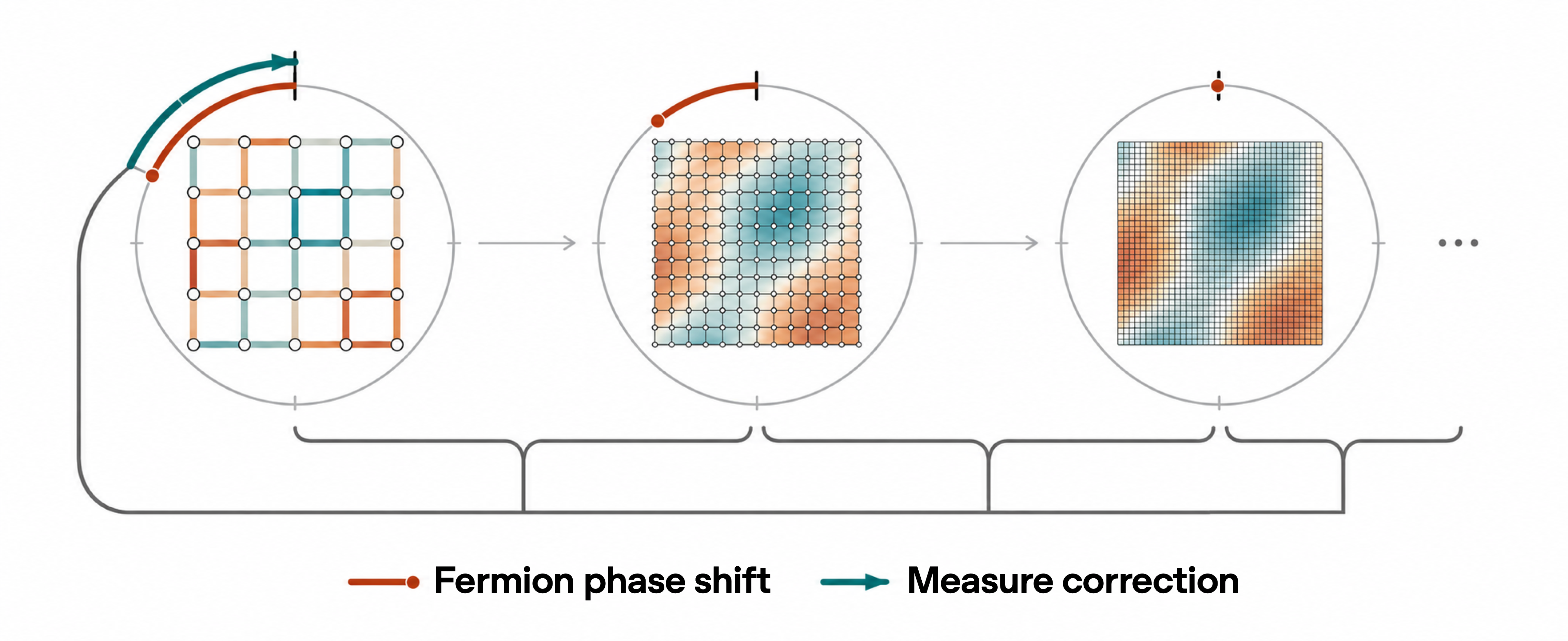
图里从左到右是三套越来越细的格子,再往后还有省略号。橙色弧线标的是左手费米子在这一圈里拾到的相位,先出现在原始格子上,再出现在更细的格子上。相邻两套格子被括号两两配对。把这些弧线的差值加起来,就能恢复原始格子上的相位移动。蓝绿色箭头把这个移动抵消掉,让费米子测度回到起始相位。图注署名为Nathaniel Craig/GPT-6 Astra。
媒体未能载入,请通过下方原文链接查看。
重叠费米子可以在格子上只留下想要的左手费米子,并去掉那些加倍出来的伙伴。可它并没有告诉人们该怎样设定相位。Craig写,这里说的相位和手性镜子思想实验里的相位相当不同,但这个类比仍然有用。困难在于,格子上的相位取决于标准模型的力在每一个格点上正在做什么。Lüscher已经为更简单的一类理论给出了相位规则,例如手性版本的电磁学。完整标准模型的对齐问题,却又悬了二十多年。
一个办法是:从格子上某一组力的配置出发,在力场小步变化时跟踪那些被允许的左手费米子。如果再走一串步骤,让力场回到起点,终点允许的态和起点相同,可是把这些态绕这一圈带回来的方式,可能留下一个不同的相位。在盒子里,人们靠转动镜子来补偿光跑一圈拾到的相位。在格子上,必须找出办法,补偿每一圈拾到的相位。
把同一组力场搬到一层层更细的格子上
Craig的想法是:在要定义理论的那张格子上取出力场,再把同一组场表示到一层层更细的格子上。比较相邻两套格子上被允许的费米子态,就能得到力场发生一个小变化时相位校正的一部分。把这些部分加起来,就得到原始格子上的相位规则。证明表明,它在每一条被允许的圈上都给出正确的校正。某一处发生变化时,校正主要取决于附近的场;对同一组场的不同数学描述会给出同一个答案。这样,在格子间距有限、并且格子尺度上的场强受到限制的条件下,就得到了标准模型的测度。
把这套细化策略做成证明,经历了多轮与Astra的合作,以及和外部专家的讨论。Craig写,GPT-6 Astra对把细化想法做成可工作的构造至关重要:它建议了把给定力场搬到更细格子上的正确方式,说明了更细格子上的比较会收敛到一个确定答案,并在详细证明里起了主导作用。格子场论学者Maarten Golterman、Andreas Kronfeld和Yigal Shamir花时间审看了Astra的证明,提出了追问,这些帮助Craig建立起对结果的信心。他写道,他们在这个问题上的经验和提出的问题,在构造成形过程中非常宝贵。这是Craig本人对审看过程的记述,并不是这三位学者发表的正式背书声明。
候选定义,还不能直接拿去跑真实模拟
结果是一个标准模型的候选非微扰格子定义,有可能回答一个悬了五十多年的问题。Craig把这次构造说得更像开始,结束还在后面。要判断这套处方是不是具备人们希望的全部性质,还需要专家之间的科学讨论。他和Astra提出的方法,远更像原则上的答案。要让它能用于真实的格子模拟,前面还有大量工作。他当时想得很多的一个问题是:在有限格子间距上,这套构造是否满足反射正性。这个条件有助于把格子模型里的计算,连接到一个概率守恒的量子理论。
这套构造也还没有回答,怎样在连续时空里定义有相互作用的理论。Craig写道,OpenAI最近对杨-米尔斯理论存在性的证明提供了缺的那一块拼图,标准模型里的强力和弱力都是杨-米尔斯理论的例子。据他的转述,这使OpenAI得以证明,从格子上的重叠费米子出发并取连续极限后,包含标准模型规范场和费米子的最简单统一杨-米尔斯理论是存在的。这是Craig对OpenAI近期工作的引述,本文没有单独核验那份证明。他对这些进展会推动人们进一步理解标准模型持乐观态度。
若要判断这套处方够不够格,需要看专家讨论,以及反射正性等问题能否收口。要核对构造细节,应直接读2026年10月6日提交的预印本arXiv:2610.09093,以及这篇2026年11月15日的客座文章。现在不宜把它写成标准模型已经被完整定义,或已经可以拿去跑真实格子模拟。
原文
A step toward defining the Standard Model on a lattice
媒体未能载入,请通过下方原文链接查看。
A step toward defining the Standard Model on a lattice
November 15, 2026
In the first guest post on our science blog, physicist Nathaniel Craig, a visiting scientist at OpenAI, describes how he worked with GPT-6 Astra on a candidate lattice definition of the Standard Model. Craig leads the particle theory group at the University of California, Santa Barbara, and is a permanent member of its Kavli Institute for Theoretical Physics.
The Standard Model of particle physics is an extraordinarily successful theory of nature, describing the known elementary particles and three of the four fundamental forces—the strong force, the weak force, and electromagnetism. The success of the theory rests on outstanding agreement between theoretical calculations and experiments across eighteen orders of magnitude, from the low energies of hydrogen’s 21-centimeter radio emission to the high energies of collisions at the Large Hadron Collider. And yet for all of its successes over the more than fifty years of its existence, a foundational problem remains: how to give the full theory a nonperturbative definition, one that does not rely on treating its interactions as small corrections. In an October preprint prepared with the aid of GPT-6 Astra, I proposed a candidate definition on a lattice—a grid representing spacetime.
I had a strategy for tackling this problem, but had not been able to prove that it worked in all the cases it needed to cover. Astra helped turn that strategy into a construction and took the lead in developing the detailed proof. To explain what we did, it helps to start with what is missing from our existing description of the Standard Model.
What is missing from the Standard Model’s definition?
What does it mean to say that we lack a definition of the Standard Model? Quantum mechanics and special relativity tell us how the particles and forces of the Standard Model interact. Unfortunately, we don’t yet know how to make complete predictions based directly on these interactions. Instead, we often start by imagining that the interactions are turned off, so that electrons would no longer repel each other. We can solve that problem exactly, then put the interactions back in as a series of small corrections. When the corrections get progressively smaller, a few terms can give a remarkably precise answer—for example, it has allowed physicists to predict the strength of the electron’s magnetism to within a few parts in a trillion. This approach is known as perturbation theory.
However, much of the richness of the Standard Model lies outside the realm of perturbation theory. Take the mass of the proton: the proton is made up of three quarks, but its mass comes primarily from the motion and interactions of the quarks and the strong force-carrying gluons inside it. If you turn off the strong force, the proton falls apart entirely, so perturbation theory is not a useful guide to understanding the size of the proton’s mass. More powerful methods are needed to access information about the theory nonperturbatively, where the interactions are present from the start and not treated as small corrections.
For the full Standard Model in continuous spacetime, we don’t have a nonperturbative definition, or even an understanding of whether the interacting theory is mathematically well defined. A promising alternative is to discretize spacetime into a grid of points, known as a lattice. The spacing of the grid defines the shortest distance our theory can resolve, and studying a finite grid allows us to give a rigorous nonperturbative definition of the theory at a given spacing. It also enables us to put the theory on a computer, where we can calculate its predictions directly without resorting to perturbation theory. This approach, known as lattice field theory, has led to remarkable progress in our understanding of the strong force over the last few decades, including a quantitative understanding of the mass of the proton from first principles.
Left-handed particles
If lattice field theory has been so successful for the strong force, why haven’t we extended it to a nonperturbative lattice definition of the entire Standard Model? Here a crucial difference stands in the way: the Standard Model is an example of what is known as a chiral theory.
A chiral theory is one that looks different under reflection in space. Think of gloves in a mirror: the mirror image of a left-handed glove is a right-handed glove. If you have one of each kind, the mirror image does as well, so your collection of gloves looks the same under reflection in space. But if you only have a left-handed glove, the right-handed glove in the mirror is different.
This notion of handedness extends to many of the fundamental particles in the Standard Model, known as fermions, including quarks and electrons. Most forces in the Standard Model are not chiral: the strong force and electromagnetism, for example, treat left-handed and right-handed fermions in the same way. Such theories can be put on a lattice more readily.
But the third fundamental force of the Standard Model, the weak force, lacks this reflection symmetry. It treats left- and right-handed fermions differently, and so does not look the same under mirror reflections that exchange left and right. This treating of different-handed particles differently is what makes the Standard Model a chiral theory. And it turns out that putting chiral theories on a lattice is profoundly challenging. If we try to put a left-handed fermion on the lattice, the most natural rules give you a right-handed partner you never asked for. This is a surprising outcome, which we’ll unpack momentarily. Whatever the reason, this means a straightforward lattice formulation of the Standard Model gives the wrong particle content for the weak force. Doubling is one reason a complete nonperturbative definition of the Standard Model has been missing since the theory took shape.
An analogy with light and mirrors
To understand doubling, consider an analogy with light. Light has two polarizations, which describe the orientation of the electric field as the light moves through space. (This is familiar if you wear polarized sunglasses, which block the horizontally-polarized light that reflects off water or roads while letting through vertically-polarized light.) Although polarized sunglasses pick out a basis of horizontal and vertical polarizations, for our analogy it will be more useful to pick a basis where these two polarizations are left-circular and right-circular, meaning that the electric field is rotating either clockwise or counterclockwise around the direction of motion. As we’ve said, electromagnetism is reflection-symmetric, so its actual laws are the same for both left-circular and right-circular polarizations. (For the technically inclined, left and right refer to chirality when we talk about fermions. In our analogy with light, they refer to the photon’s helicity, which tells us whether its spin points along or against its direction of travel.)
But imagine you wanted to emulate a world with only left-circular light, akin to the way the weak interactions single out left-handed fermions. To study this in the lab, you could put a laser producing left-circular light into a box with a mirror at either end. The light could build up as it bounced back and forth, allowing you to study it carefully—kind of like putting the Standard Model on a lattice. In each case you are bounding the accessible length scales of the theory to gain control—the lattice bounds the shortest accessible distances, while the box bounds the longest distances.
If you built the box using ordinary mirrors (like putting a chiral theory on the lattice in the most straightforward way), you’d be in for a surprise: the left-circular light coming out of the laser becomes right-circular when it bounces off the mirror at the other end, so now the box contains both polarizations of light. This occurs because the mirror reverses the direction of the light without changing how the electric field is rotating (as seen from the same end of the box), which flips the polarization. This is a bit like the appearance of doublers when you put a left-handed fermion on the lattice. You supplied only left-handed light, and the box supplied the other hand.
There is a clever fix. You can make a chiral mirror using special films whose molecules line up in layers. The alignment turns a little from one layer to the next, tracing a spiral down into the film. For light whose wavelength and handedness match the spiral, the small reflections from different layers reinforce one another, flipping the rotation of the electric field in the light that bounces back. The film sends left-handed light back left-handed and lets right-handed light pass through. Such chiral mirrors have been around for more than a decade, and the phenomenon even occurs in nature: some scarab beetles have a similar spiral in their shiny shells. If you constructed your box using chiral mirrors, then the light traveling in both directions would be left-circular.
A similar trick works on the lattice: decades ago, Paul Ginsparg and Nobel laureate Ken Wilson 1 worked out the lattice rules analogous to the requirement that chiral mirrors reverse the rotation of the electric field upon reflection. Rajamani Narayanan and Herbert Neuberger 2 built the analog of the chiral mirrors by finding the necessary definition of fundamental particles on the lattice, known as overlap fermions. Finally, Martin Lüscher 3 showed how to tell the difference between left-handed and right-handed overlap fermions on the lattice, while Yoshio Kikukawa 4 and collaborators explored how this might be used to describe weak interactions in the Standard Model. However, one piece was still missing.
Getting the phase right
To identify that piece, let’s come back to our box with chiral mirrors. The circular polarization of light tells us which way the electric field turns as light propagates, but there’s another important property of the light in our experiment: the optical phase. Imagine water waves rolling past the pilings of a dock, and watch the water rise and fall at one piling. The wave’s phase is the stage of that rise and fall you catch it in when you look, perhaps just past its highest point and on its way down. For our circularly polarized light, the optical phase tracks the same kind of cycle at a fixed spot in the beam, with the electric field pointing up at the “crest” and down at the “trough.”
The relative phase of two waves determines how much they add or cancel at the same point. At one piling of a dock, two waves arriving in phase lift the water higher as their crests meet, while a crest arriving with a trough can leave the water close to its usual level. Similarly, light with the same phase in the same place builds up, while light with different phases can cancel out. In our box with chiral mirrors, left-circular light is now bouncing back and forth inside the box. After a lap, the returning light meets fresh light from the laser going in the same direction. If their electric fields are in step, they reinforce and the light builds up inside the box. If the fields are half a cycle apart, they point in opposite directions and the returning light cancels some of the fresh light. To build up a strong beam, we want the phase of each return to arrive in step with the source.
To get the phase right, we can rotate one chiral mirror relative to the other. Imagine a mark at twelve o’clock on the rim, and spin the mirror about the beam as though the beam were its axle. Moving the mark to three o’clock turns every layer of the film by a quarter turn and shifts the phase of the reflected light by half a cycle. We can set the angle to make up for the phase accumulated on the rest of the trip. Once the returning light arrives in step with the laser, we have a splendid laboratory for studying purely left-handed light.
Imagine changing the force fields until they return to where they started. The orange arcs show the phase the left-handed fermions pick up on that round trip, first on the original grid and then on finer ones. Each bracket pairs two neighboring grids. Adding up the differences between their arcs recovers the phase shift on the original grid. The teal arrow undoes that shift, bringing the fermion measure back to its starting phase.
Nathaniel Craig/GPT-6 Astra
On the lattice, overlap fermions give us a way of keeping only the left-handed fermions that we want, and getting rid of the doublers. But this doesn’t tell us how to set the phase. (The phase in question is quite different from the one we’ve encountered in our chiral mirror thought experiment, but the analogy is good.) On the lattice, this becomes tricky because the phase depends on what the forces of the Standard Model are doing at every grid point. Lüscher worked out the phase prescription for a simpler class of theories such as a chiral version of electromagnetism, but the alignment for the full Standard Model remained open for more than 25 years.
We can try to assign a phase by starting with one configuration of forces on the lattice and following the allowed left-handed fermions as we change the force fields in small steps. Now take a series of steps that bring the force fields back to where they started. The same states are allowed at the end, yet the way we carried them around the loop can leave us with a different phase. In the box, we adjusted the mirror to compensate for the phase the light picked up on a lap. On the lattice we have to work out how to compensate for the phase picked up around every loop.
Building the construction with Astra
My idea was to take the force fields on the grid where we want to define the theory and represent those same fields on a succession of finer grids. Comparing the allowed fermion states on two successive grids tells us one part of the phase correction for a small change in the forces. Adding up those parts gives us the phase rule on the original grid. The proof shows that it gives the right correction around every allowed loop. The correction for a change at one spot depends mainly on the fields nearby, and different mathematical descriptions of the same fields give the same answer. This supplies the measure for the Standard Model at finite lattice spacing, under a bound on field strengths at the scale of the grid.
Developing this refinement strategy into a proof required several rounds of work with Astra and discussions with outside experts. GPT-6 Astra was essential to turning the refinement idea into a working construction. It suggested the right way to carry a given set of force fields onto finer grids, showed that the comparisons on finer grids would converge to a definite answer, and took the lead in developing the detailed proof. Human experts also played a key role; lattice field theorists Maarten Golterman, Andreas Kronfeld, and Yigal Shamir graciously spent time looking over Astra’s proof and asking probing questions that helped me to build confidence in the result. Their experience with the problem and the questions they asked were invaluable as the construction took shape.
What comes next
The result is a candidate nonperturbative lattice definition for the Standard Model, potentially answering a question that had been open for more than fifty years. As with all scientific progress, however, this construction is much more a beginning than an end. Scientific dialogue among experts is required to decide if this prescription has all the properties we desire. The method that Astra and I proposed is far more an answer in principle than an answer in practice; much work lies ahead to make it useful for realistic lattice simulations. Right now I’m thinking a lot about whether this construction satisfies reflection positivity at finite lattice spacing, a condition that helps connect calculations in this lattice model to a quantum theory in which probabilities are conserved.
The construction also leaves open the question of defining the interacting theory in continuous spacetime. OpenAI’s recent proof of the existence of Yang-Mills theory (of which the strong and weak forces of the Standard Model are examples) provides the missing puzzle piece. This enabled them to prove the existence of the simplest unified Yang-Mills theory that includes the gauge fields and fermions of the Standard Model by starting with overlap fermions on the lattice and taking the continuum limit. I’m optimistic these developments will lead to new progress in our understanding of the Standard Model.
Author
Nathaniel Craig
References
- P. H. Ginsparg and K. G. Wilson, “A remnant of chiral symmetry on the lattice”, Phys. Rev. D 25, 2649 (1982)
- R. Narayanan and H. Neuberger, “Chiral determinant as an overlap of two vacua”, Nucl. Phys. B 412, 574–606 (1994)
- M. Lüscher, “Abelian chiral gauge theories on the lattice with exact gauge invariance,” §2.4, Nucl. Phys. B 549, 295–334 (1999)
- D. Kadoh and Y. Kikukawa, “A construction of the Glashow–Weinberg–Salam model on the lattice with exact gauge invariance”, JHEP 05 (2008) 095