Koray Kavukcuoglu / 文章
在xhigh思考档上,Gemini 4 Neon的智能指数是61,排第3
Google把Neon放在Carbon和Hydrogen之间。每百万输入3美元、输出15美元,上下文100万token。默认高思考档完成任务的成本比Carbon低32%。
乔木改写
在Artificial Analysis智能指数的xhigh思考档上,Gemini 4 Neon得了61分,总排名第3,官方写它排在更大、也更慢的模型后面。同一天公布的默认高思考档里,它完成任务的成本比Carbon低32%。
这是Google DeepMind首席AI架构师Koray Kavukcuoglu在2026年11月18日的介绍文章。Neon被放在Gemini 4家族中间:Carbon负责最难、跨度更长的项目,Hydrogen负责很快的日常执行,Neon则用来做复杂、又高频发生的工作,强调又快又省。

媒体未能载入,请通过下方原文链接查看。
价格是每百万输入token 3美元,缓存输入是0.15美元,也就是95%折扣;输出是每百万token 15美元。上下文窗口是100万token。当天开始在Gemini API的Google AI Studio、Gemini for business的API和模型列表、付费Google AI Pro和Ultra用户的Google Antigravity,以及Pro和Ultra用户的Gemini应用里滚动推出。网络安全方向会在随后几天向Fairwind计划的合格成员开放。
企业、科学和智能体评测里的分数
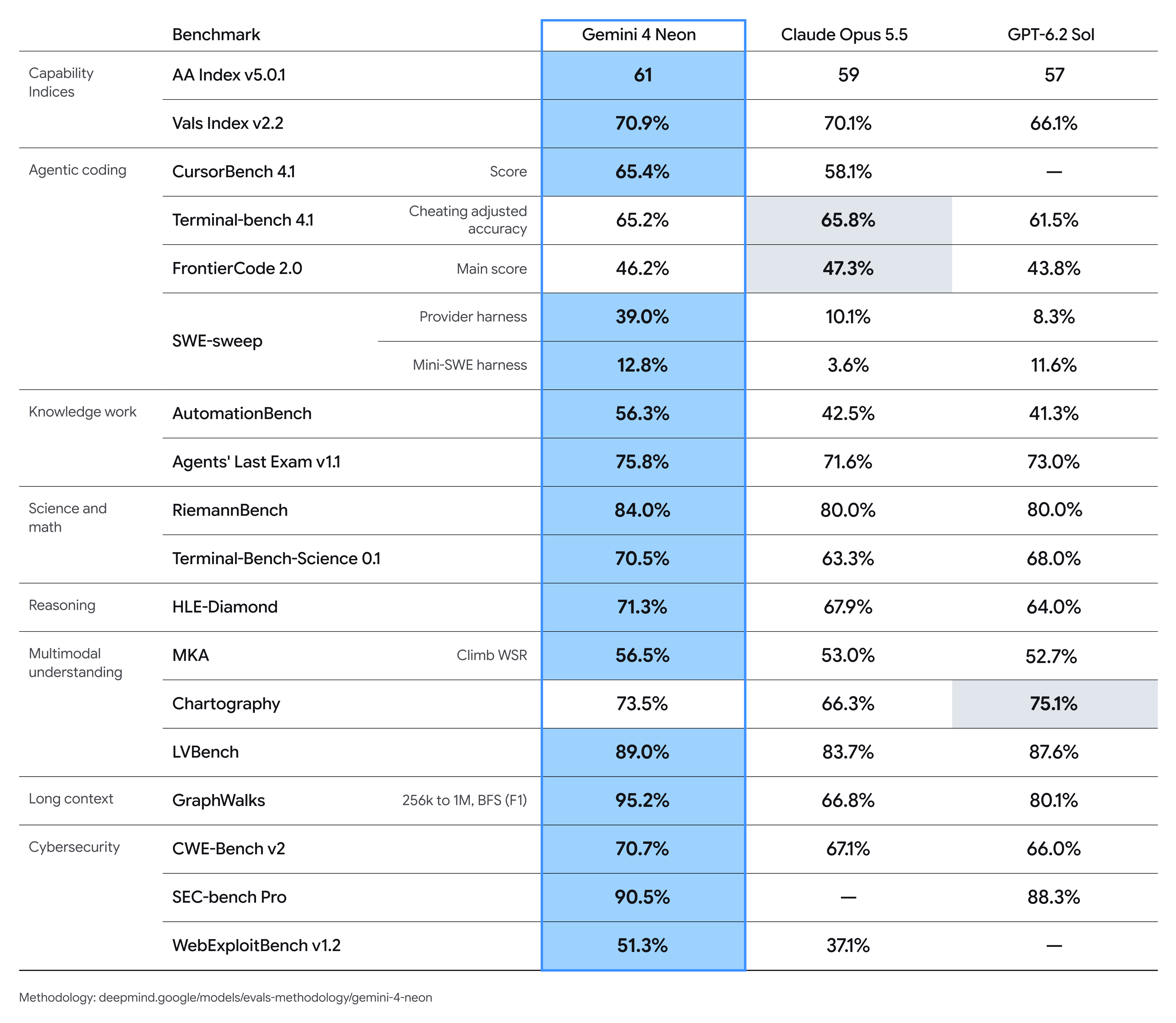
官方把Neon写成能在同一个100万token窗口里处理表格、PDF、图表、音频和视频,并输出结构化交付物。独立评测方面,Vals Index上它排第2,分数是70.9%,并处在帕累托前沿;在Legal Research Bench和Tax Agent Bench上排第1。
在Surge AI上,官方写它在金融、会计、表格建模和复杂约束遵循的多数基准里排第1。Chartography上是73.5%,用来读密集的专业图表;Agents' Last Exam v1.1上是75.8%,官方的说法是和领先模型相当。Zapier的AutomationBench是56.3%,总排名第1;Andon Labs的Vending-Bench 2是16843美元,这也是总排名第1,评测本身是一个长时间经营生意的模拟。Arena新的Agent Arena Index上,它在4200多场真实智能体会话里得到1336分,全球第2,可操控性(中途按用户修正调整)也排第2。
科学和数学推理方向,官方称它在Terminal-Bench Science(70.5%)、RiemannBench(84.0%)和HLE-Diamond(71.3%)上是同类最好。这些分数来自官方介绍,不是这次独立复跑的结果。
媒体未能载入,请通过下方原文链接查看。
编码和网络攻防数字
编码部分,Neon在Artificial Analysis Coding Agent Index上总排名第1,分数是58.6;Terminal-Bench 4.1是65.2%;FrontierCode 2.0在默认高档上是46.2%。官方写它适合长程、工具很多的智能体流程,既可以单独跑,也可以在Antigravity里当编排器,指挥并行的Hydrogen子智能体。SWE-sweep上,它在mini-SWE框架里是12.8%,官方写这已是领先;在Google Antigravity里升到39.0%,约为原来的三倍多,官方把它写成该方法能解锁的结果。
文章还用文字描述了几段Antigravity演示:用/swarm做一张元素对应的三维实验台,碳和氢配本生灯火焰,氩和氖配高压放电管;从零写一个WebGL2第一人称滑雪模拟,自定义着色器约10200行,在勃朗峰和霞慕尼的真实高程上跑120赫兹的滑雪物理,六条高山线路,并带空间Web Audio,官方写没有使用现成素材;用档案照片重建艾伦·图灵1936年在剑桥国王学院的书房,桌上有一台可运行的通用图灵机;把一张图变成有10万个单元格的Google表格,不用内嵌图片和Apps Script,而用超过50万个实时公式做边缘检测、三维深度和六种重打光。这些演示没有附上可播放的视频文件,上面只是官方自己的文字说明。
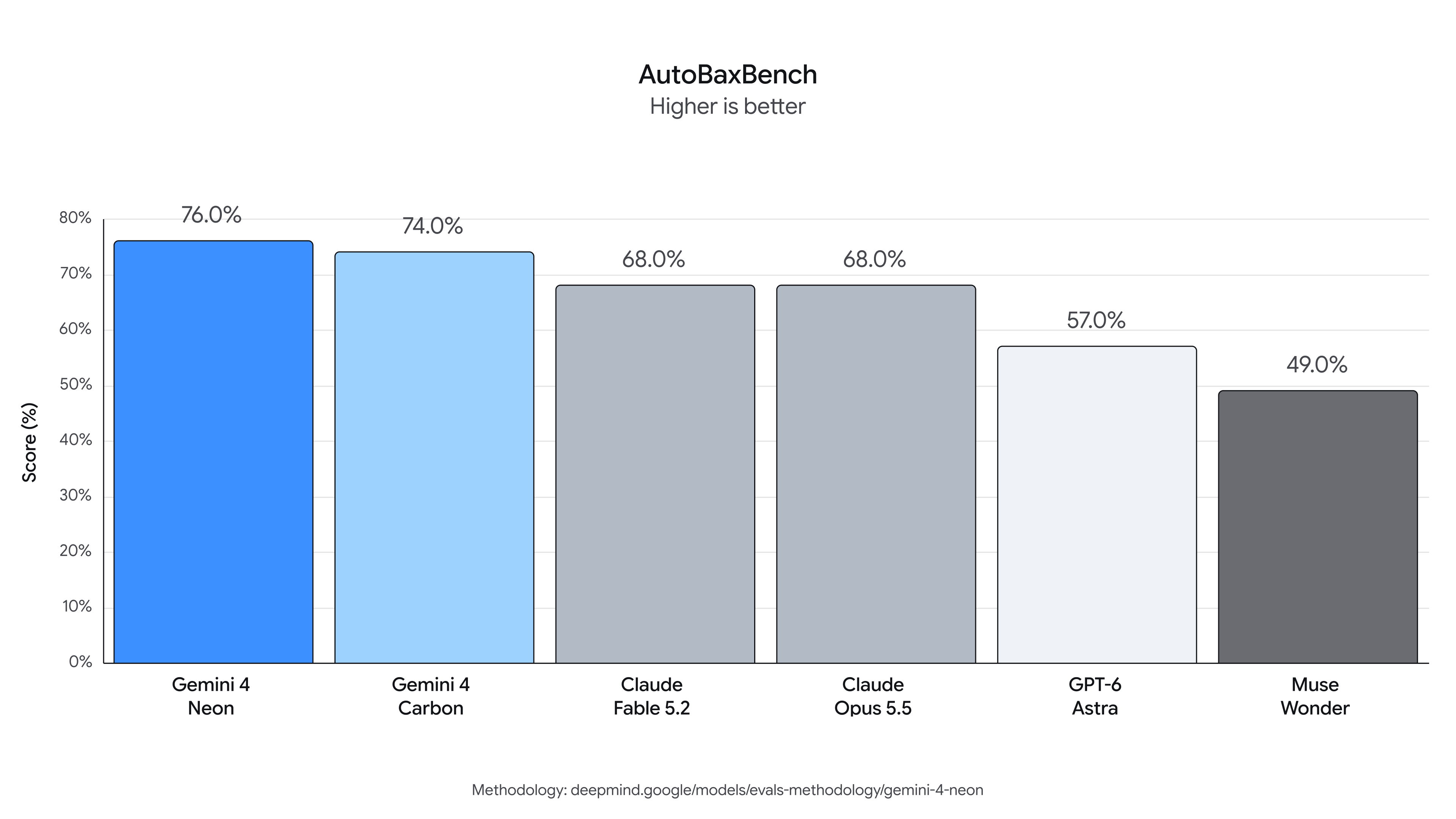
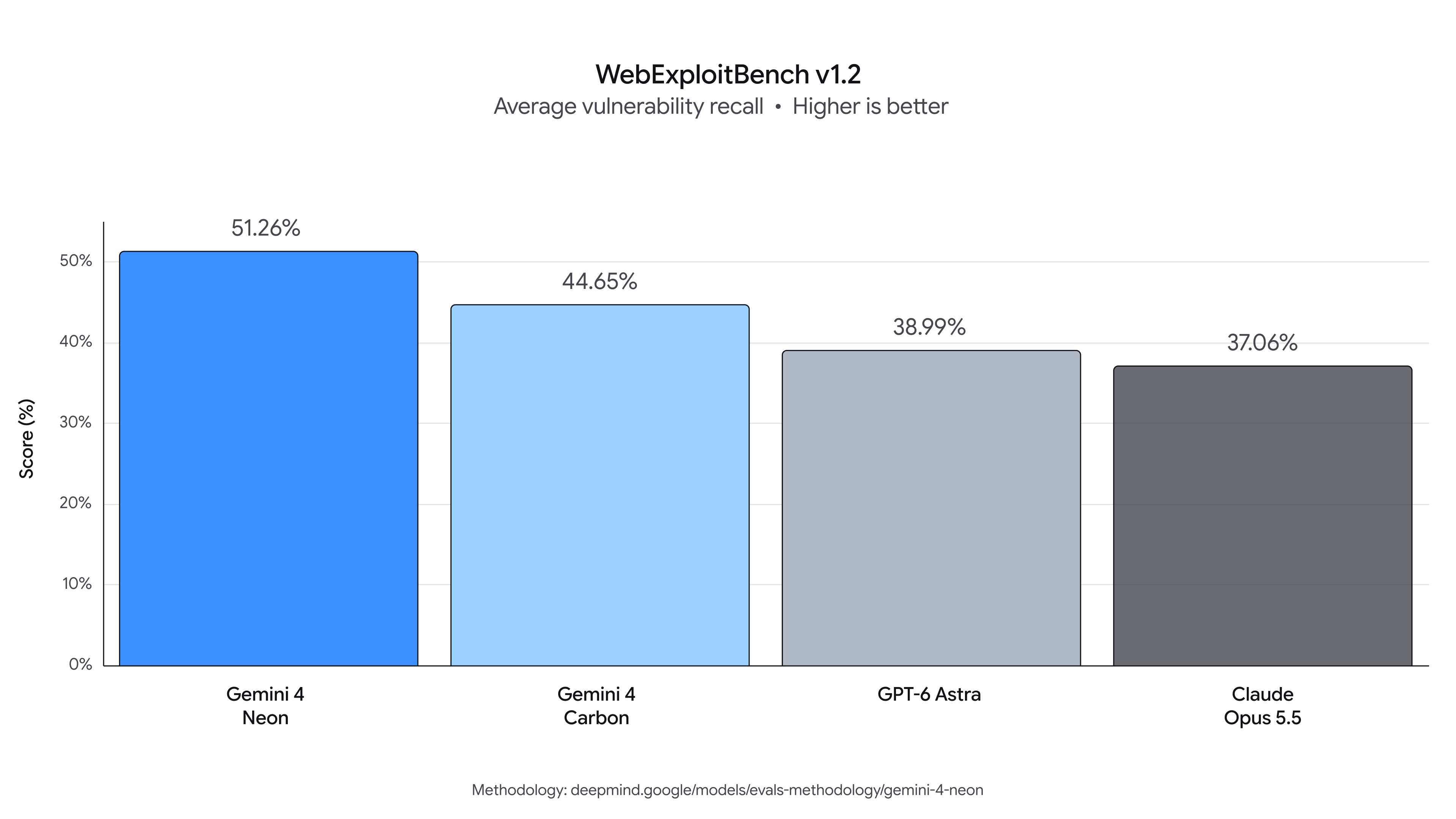
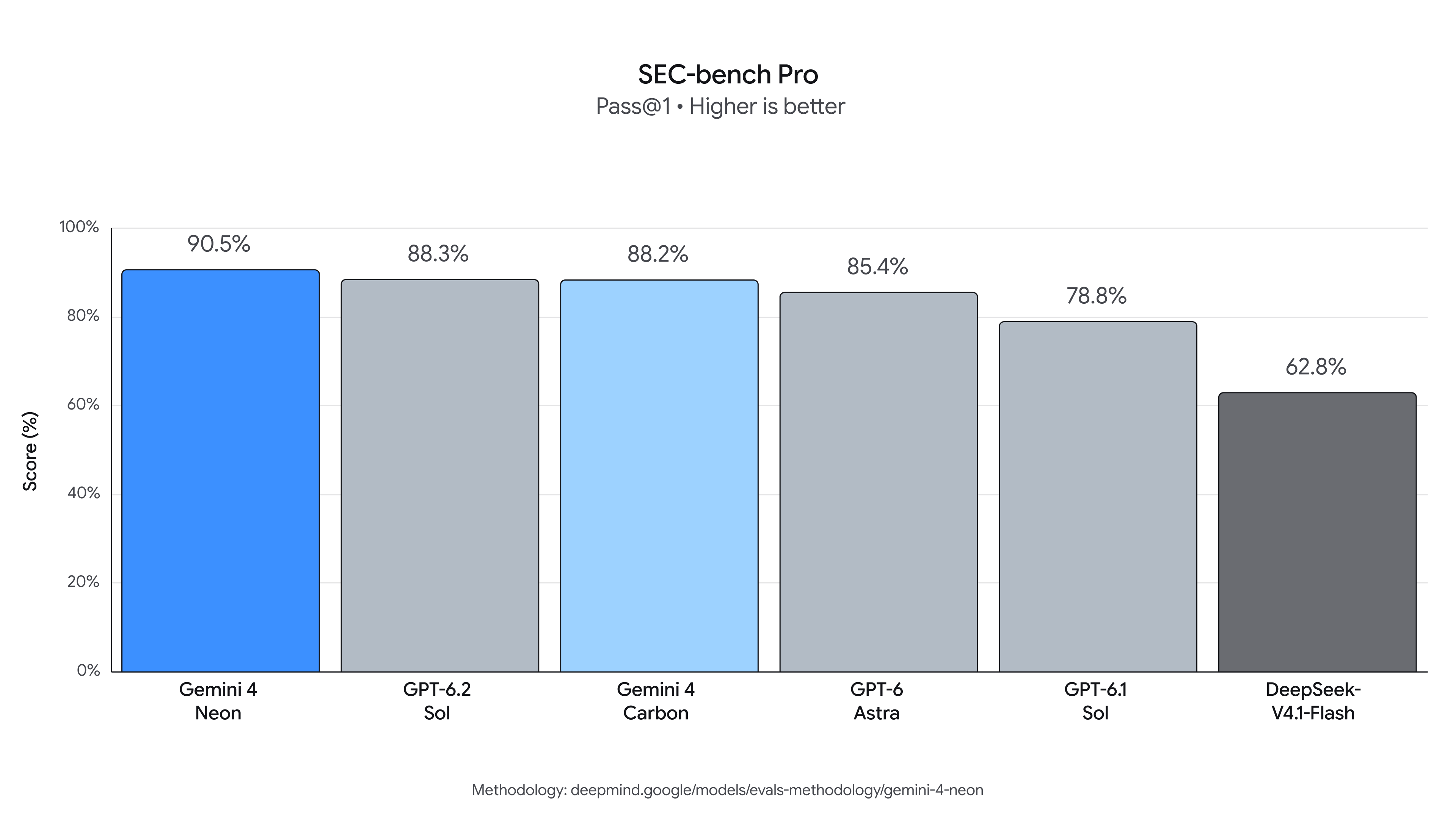
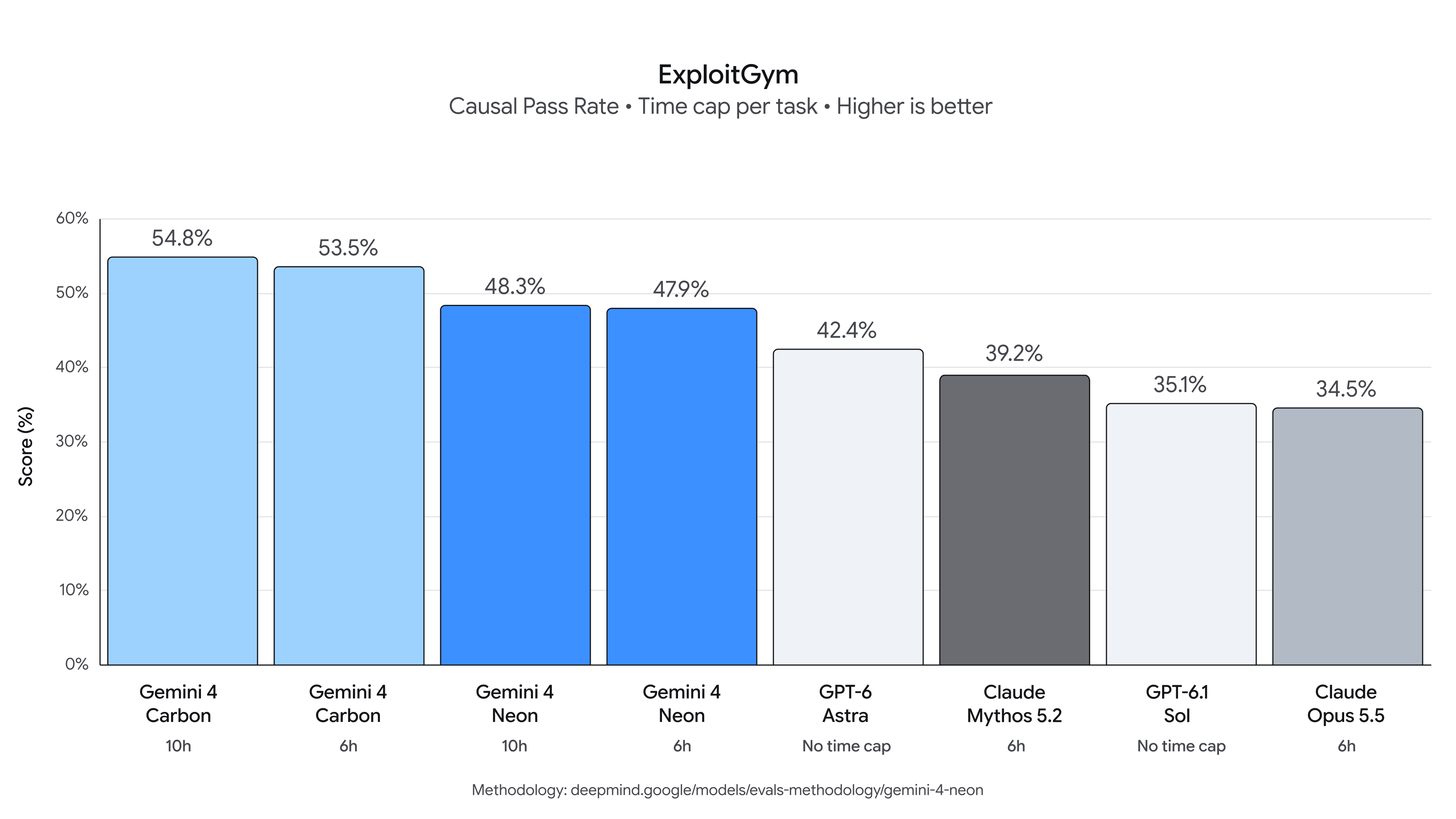
网络安全一节把Neon写成「Gemini 4 Neon for cyber」。AutoBaxBench上,官方写它在易、中、难三档都比Carbon写出更安全的代码,难档是76%,并称为当时最好。WebExploitBench v1.2上是51.26%,官方写成本大约是大型竞争模型的一半。SEC-bench Pro上是90.5%,官方同样写每道题成本大约减半。ExploitGym上只写了前沿水平,并且token用量是Carbon的一半,没有另给百分数。Collinear的CWE-bench v2上是70.7%,比Carbon高3.4个百分点。
媒体未能载入,请通过下方原文链接查看。
媒体未能载入,请通过下方原文链接查看。
媒体未能载入,请通过下方原文链接查看。
媒体未能载入,请通过下方原文链接查看。

媒体未能载入,请通过下方原文链接查看。
安全数字和它在家族里的位置
安全一节写,Neon沿用Gemini 4的安全和安保栈,对严重滥用和提示注入的保护与Carbon相当,并继续改对齐和智能体行为。因为这个模型更快、更便宜,又被写成前沿能力,官方说实时防护要向Carbon看齐,同时少拒掉正当工作:Terminal-Bench 4.0上拒答是1.98%,Terminal-Bench-Science上是0%。Terminal-Bench 4.0上作弊率是0.0%,和Carbon一样;在他们的编码作弊评估里走捷径的比例是2.45%,官方写这是Gemini 4里最低的。智能体安全套件上,动作偏离率是0.09%;智能体诚实评估通过率是99.2%。和Carbon相比,服务不足下降了43%到56%,越权下降了15%到35%,这两个区间随不同用力档变化。
间接提示注入方面,官方引用Gray Swan的IPI基准,写在最高思考档并打开实时防护时,Neon挡住了该基准里的每一次攻击,攻击成功率0.0%,和他们给出的其他Gemini模型结果相同。

媒体未能载入,请通过下方原文链接查看。
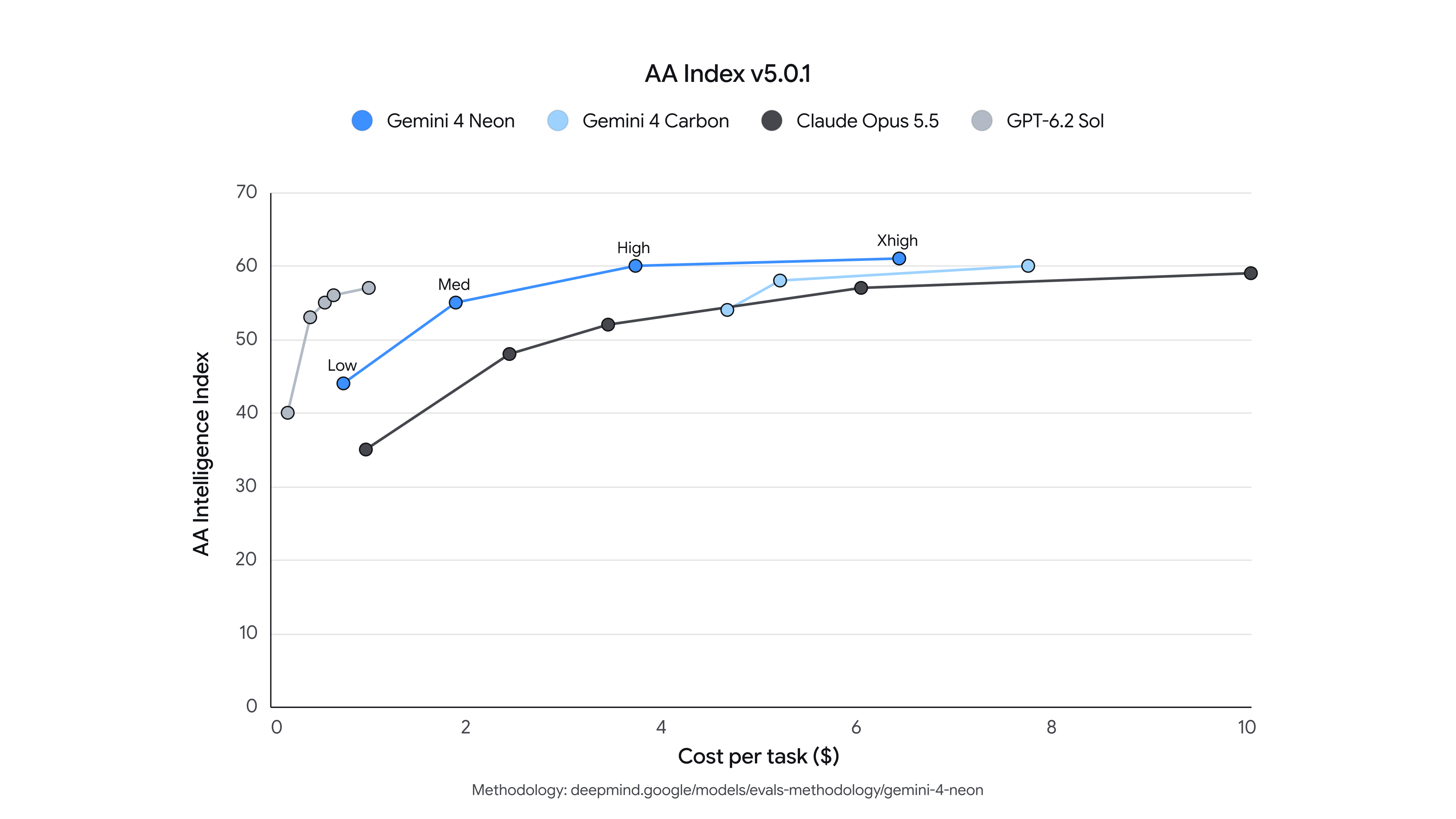
思考档有四档,用来在智力和token花费之间调节。默认是高档。官方写,在高档上它处在Vals Index和Agent Arena的帕累托前沿,完成任务的成本比顶级竞争前沿模型大约低50%到80%;xhigh用于最难的工程、分析和科学工作,智能指数在这一档最高,同时完成任务的成本仍比竞争模型最高档低36%以上。官方还写,内部Antigravity测试里,它的编造率是他们迄今最低的,但没有给出具体数字。
媒体未能载入,请通过下方原文链接查看。
更完整的模型说明在Gemini 4 Neon模型卡:https://storage.googleapis.com/deepmind-media/Model-Cards/Gemini-4-Neon-Model-Card.pdf。如果要在Carbon和Hydrogen之间选一个又快又够用的生产档,先对照官方自己的成本/任务数字和模型卡,再按自己的工作负载试,不要只看总排名。
原文附带媒体
原文附带官方文章朗读音频;未核验其与具体段落的对应关系。
媒体未能载入,请通过下方原文链接查看。
原文
Introducing Gemini 4 Neon
媒体未能载入,请通过下方原文链接查看。
媒体未能载入,请通过下方原文链接查看。
媒体未能载入,请通过下方原文链接查看。
媒体未能载入,请通过下方原文链接查看。
媒体未能载入,请通过下方原文链接查看。
媒体未能载入,请通过下方原文链接查看。
媒体未能载入,请通过下方原文链接查看。
媒体未能载入,请通过下方原文链接查看。
媒体未能载入,请通过下方原文链接查看。
媒体未能载入,请通过下方原文链接查看。
Introducing Gemini 4 Neon
Nov 18, 2026
By Koray Kavukcuoglu
Bringing frontier-level intelligence with fast end-to-end task completion across complex software engineering, knowledge work, and science workflows.
Today, we’re introducing Gemini 4 Neon — bringing frontier-level intelligence with fast end-to-end task completion across complex software engineering, knowledge work, and science workflows.
Neon ranks ahead of comparable models and #3 overall with a score of 61 on the Artificial Analysis Intelligence Index at its xhigh thinking level, landing just behind larger, slower models. On the Vals Index, Neon ranks #2 and lands on the Pareto frontier. Beyond just pushing on raw model capability, we’re continuing to make our models better to work with, Neon ranks #2 on steerability (adapting cleanly to mid-task user corrections) on the new Agent Arena Index. Neon also excels at multi-step instruction following and builds on our ongoing progress to curb fabrication, recording our lowest fabrication rate yet in internal Google Antigravity testing.
The model is priced at $3 per million input tokens ($0.15 per million cached input tokens, a 95% discount) and $15 per million output tokens, with a 1 million-token context window.
Gemini 4 Neon is rolling out today in the Gemini API in Google AI Studio, Gemini for business (via API and model dropdown), for paid Google AI Pro and Ultra subscribers in Google Antigravity, and for Pro and Ultra subscribers in the Gemini app.
Delivers across enterprise, analytical, and scientific work
Enterprise work lives in spreadsheets, PDFs, charts, audio, and video. Neon can synthesize across all of these inputs in a single 1 million-token context window and turns inputs into structured deliverables. Independent evaluations rank Neon as one of the top models and on benchmarks like the Vals Index, it ranks #2 (70.9%), and reaches #1 on both the Legal Research Bench and Tax Agent Bench.
Neon also shows strong wins across categories on Surge AI, ranking #1 on most benchmarks across finance, accounting, spreadsheet modeling, and complex constraint following. It also scores 73.5% on Chartography for reading dense professional charts and performs on par with leading models on Agents' Last Exam v1.1 (75.8%). It achieves #1 overall on both Zapier’s AutomationBench (56.3%) and Andon Labs' Vending-Bench 2 ($16,843), a long-horizon simulation of running a business. Finally, it debuts #2 globally with a score of 1336 on Arena's new Agent Arena Index across 4,200+ real-world agent sessions.
On scientific and mathematical reasoning, spanning quantitative analysis, mathematics, and technical research problems, Neon is best in class on Terminal-Bench Science (70.5%), RiemannBench (84.0%), and HLE-Diamond (71.3%).
Built for production-ready code
Engineered for long-running agent workflows, Neon sustains performance through complex, tool-heavy tasks end-to-end — whether running standalone or acting as a fast, high-judgment Orchestrator directing parallel Hydrogen subagents in Google Antigravity. It cuts down on redundant file reads, shares progress as it works, and handles context compaction reliably in long sessions.
Across core developer and researcher workflows, Neon achieves frontier performance and is competitive with the leading models in its class, ranking #1 overall on the Artificial Analysis Coding Agent Index (58.6), with a score of 65.2% on Terminal-Bench 4.1 and46.2% (at its default high setting) on FrontierCode 2.0. For production-ready code, Neon handles multi-file debugging and refactoring across repositories with targeted, surgical edits. On SWE-sweep, it already leads on the mini-SWE harness (12.8%) and more than triples to a state-of-the-art 39.0% in Google Antigravity showing what the Antigravity harness unlocks.
Driving Blender MCP in Google Antigravity, Gemini 4 Neon used /swarm to build a photorealistic 3D lab bench visualizing the model names with elemental accuracy pairing Bunsen flames for Gemini 4 Carbon and Gemini 4 Hydrogen with high-voltage gas discharge tubes for Gemini 4 Argon and Neon.
In Google Antigravity, Gemini 4 Neon wrote a first-person WebGL2 freeride ski simulator from scratch on real Mont Blanc and Chamonix elevation terrain — combining 10,200 lines of custom shaders, 120 Hz ski physics across six alpine lines, dynamic carved tracks, slab avalanches, and spatial Web Audio with zero pre-made assets.
Using /swarm in Google Antigravity, Gemini 4 Neon pulled archival photos to recreate Alan Turing’s 1936 study at King’s College, Cambridge in interactive 3D — from King’s Chapel outside to Room X.8 inside, complete with a working Universal Turing Machine running on his desk.
In Google Antigravity, a Gemini 4 Neon agent swarm turned a single image into a 100,000-cell Google Sheet with zero embedded images and zero Apps Script — using over 500,000 live spreadsheet formulas to run edge detection, map 3D depth, and relight the scene across six interactive modes.
Brings efficiency and control to production-grade workflows
We’re refining thinking levels with each new model release to give teams finer control and a smoother progression from one tier to the next. Neon’s four levels scale steadily, letting teams dial intelligence and token spend to what each workload needs.
Neon delivers high performance at a lower cost per task across third-party benchmarks. At its default high thinking level, it pairs a high Artificial Analysis Intelligence Index score with a 32% lower cost per task than Carbon. It also sits on the Pareto frontier on both the Vals index and Agent Arena at high, with roughly 50% to 80% lower cost per task than top competing frontier models. xhigh thinking adds deeper, multi-step reasoning for the hardest engineering, analytical, and scientific workloads. Neon shows its highest intelligence score here, while still costing 36%+ less per task than competing models at their highest setting.
Built for fast, efficient, frontier-level cyber defense
As agentic coding scales, generating secure code from the start is critical. Gemini 4 Neon for cyber produces more secure code than Carbon across all easy, medium, and hard challenges on AutoBaxBench, achieving state-of-the-art on the hard tier (76%).
Securing systems also means proactively finding flaws before attackers do. Penetration testing has served as a cornerstone of enterprise cybersecurity. On WebExploitBench v1.2, Neon is state-of-the-art (51.26%) at half the cost of competing large models.
To fortify existing code, Neon for cyber delivers frontier-level performance across the code hardening lifecycle — vulnerability finding, validating, and patching — all while being faster and more cost efficient than large frontier models.
- Finding code vulnerabilities: Neon achieves state-of-the-art performance on SEC-bench Pro (90.5%), while costing roughly half as much per challenge.
- Validating risk through exploitation: To prioritize which vulnerabilities to remediate, defenders rely on models to check which vulnerabilities are exploitable. On ExploitGym, it achieves frontier-level performance using half the tokens of Carbon.
- Patching vulnerabilities: Fixing the root cause of vulnerabilities is a critical step in the cybersecurity defense lifecycle. Neon reaches 70.7% on Collinear’s CWE-bench v2, driving a 3.4% uplift over Carbon.
Gemini 4 Neon for cyber is rolling out to trusted defenders in the coming days as part of the Fairwind Program.
Designed for safe, dependable execution
Gemini 4 Neon builds on improvements from our Gemini 4 safety and security stack— maintaining Gemini 4 Carbon-level protections against severe misuse and prompt injection while advancing further on model alignment and agentic behavior. For a model meant to carry demanding, long-running work in production, we concentrated on:
- Mitigating frontier misuse safety risks: Because Neon brings frontier-level capabilities to a faster, lower-cost model, we paired it with strong real-time safeguards against cyber and biosecurity misuse comparable to our Carbon protections, while declining far less legitimate work in these areas, refusing for instance just 1.98% of tasks on Terminal-Bench 4.0 and 0% on Terminal-Bench-Science.
- Advancing alignment and disciplined model behavior: In internal coding use, alert rates from our chain-of-thought and action misalignment monitor remained below the already low baselines set by Carbon, suggesting improved alignment propensity for Neon — and that same monitor is deployed to protect Neon across external surfaces. Neon is trained to complete multi-step work without cutting corners, fabricating results, or overstepping user boundaries — continuing to improve the balance between following through on requests and staying within scope. It matched Carbon with 0.0% cheating on Terminal-Bench 4.0 and took shortcuts on just 2.45% of tasks on our coding cheating evaluation (the lowest rate of any Gemini 4 model). It also achieved a 0.09% misaligned action rate on our agentic safety suite and a 99.2% pass rate on our agent honesty evaluation. On our agentic behavior evaluation, Neon builds on Carbon’s strong baseline by further reducing under-service by 43%–56% and overreach by 15%–35% across different effort levels.
- Protecting users from indirect prompt injection attacks: On Gray Swan's IPI benchmark, Neon is more resilient than other models in its class when malicious instructions are planted in the web pages, emails, documents, or code it accesses. We found that with real-time safeguards at its highest thinking level, Neon resisted every attack within this Gray Swan benchmark, matching the 0.0% attack success rate reached only by other Gemini models.
For more details, see the Gemini 4 Neon model card.
Built for deeper analysis
In the Gemini app, Gemini 4 Neon excels at work that requires frontier-level reasoning and fast responses.
- Higher-quality writing and knowledge work: Neon writes clearly, with well-structured responses and a natural, direct tone. It reads uploads like spreadsheets, PDFs, and photos more precisely, turns dense material into helpful reports and summaries, and pulls in relevant details from Google apps like Gmail and Docs.
- Reliable research and analysis: Neon frequently incorporates details from sources across the web to keep responses current for fast-moving topics like comparing pricing across vendors before a major purchase or pulling together a complex brief with the latest market data.
- Faster help for tougher tasks: Tasks in Gemini can now run on Neon, working through complex, multi-step jobs more quickly and efficiently than with larger models. Get more done while stretching usage limits further when handing off tedious to-dos, like analyzing billing statements to spot why a utility charge spiked or cross-checking multiple receipts and documents to negotiate a refund.
Where Neon sits in the Gemini 4 family
Neon is built for complex coding, analytical reasoning, and production-grade enterprise workflows. While Carbon tackles your hardest, long-horizon projects and Hydrogen handles fast everyday execution, Neon balances depth and efficiency. Neon delivers frontier-level reasoning for complex, high-frequency workflows faster and more cost efficiently.
Start building with Gemini 4 Neon today
Gemini 4 Neon begins rolling out today:
- For developers: Build with the Gemini API paid tier in Google AI Studio and Android Studio, if you’re a paid Google AI Pro or Ultra subscriber, you can try Neon in Google Antigravity and all Pro and Ultra subscribers can try it in AI Studio.
- For enterprises: Use Gemini 4 Neon in Gemini for business (via the API or model drop-down) and Google Antigravity.
- For consumers: If you’re a Google AI Pro or Ultra subscriber, you can select Gemini 4 Neon from the model drop-down in the Gemini app.
- For cybersecurity defenders: Eligible Fairwind Program members will begin receiving access over the next few days. To request access to the Fairwind Program, contact your Cloud account team.