Koray Kavukcuoglu / 文章
Gemini 4 Carbon今天开放,Google仍把Argon留给大多数工程任务
Gemini 4 Carbon对开发者、企业和Ultra用户开放。官方仍把Argon作为大多数软件工程和知识工作的选择,并把Carbon留给更长、更难的任务。导入价与Argon相同,2026年11月30日后将调整。
乔木改写
Gemini 4 Carbon今天向开发者、企业、科学家和消费者开放。Google把这称为目前最强的模型,并强调它在网络安全,以及知识工作、软件工程和科学推理里的长程智能体任务上,表现处在前沿。
这篇说明由Google DeepMind高级副总裁、Google首席AI架构师Koray Kavukcuoglu撰写,发布日期是2026年11月10日。两周前,Carbon先通过Fairwind项目,开放给一批网络安全防御者。在更近一次发布的Gemini 4 Argon之后,作者说Carbon把前沿又往前推了一步。
文中对两个模型的分工写得很明确。Argon仍是大多数软件工程和知识工作的理想选择。Carbon面向会把模型智力推到极限的任务,例如复杂的多步编码和排错,以及开放式的科学研究和发现。它会比Argon用掉更多token,用来更彻底地探索、更深地推理,并跑更长的验证循环。
在面向真实工作流的独立基准上,作者给出的数字是:Carbon在CursorBench 4.0、Perplexity的WANDR和Zapier的AutomationBench上排名第一,而且每个任务的成本,比表现最好的外部模型低两倍以上。这些是官方公布的基准结果,不是本文的复测。
为了把Carbon用在更大、更复杂的项目上,他们正在Google Antigravity里预览 /swarm。它把一条提示词变成一支可实时跟踪的智能体团队。开发者可以把Carbon分配给最需要深层推理的角色,例如架构设计、协调和审计,同时用更快、更轻的模型,在并行隔离的工作区里工作,并由对抗式验证器检查每一处改动。
付费开发者和企业现在可以通过Google AI Studio和Gemini for business的API使用Gemini 4 Carbon,导入价格和Argon相同:每百万输入token 2美元,每百万输出token 10美元。它也在向所有Google AI Ultra订阅用户推送,入口包括Google Antigravity、Gemini应用,以及搜索里的AI Mode。注释写明,导入期在2026年11月30日结束后,面向公开访问的Carbon将变为每百万输入token 4美元、每百万输出token 20美元。
知识工作被放到新的MKA基准上,官方演示集中在三维重建
在法律、金融和企业运营场景里,作者说Carbon会把视觉理解、推理和穷尽检索结合起来,从大量密集文档和数据里综合出有依据的见解,并按严格的模式和格式生成表格、演示文稿和报告。
他们认为,现有基准还不能很好刻画智能体如何直接处理带有图表、图像、蓝图、示意图和表格的密集文件,于是和Artificial Analysis合作推出了新的Multimodal Knowledge Agent,也就是MKA,用来测试模型在智能体工作流里的多模态表现。Carbon在这项基准上排第2,平均每个任务的成本,比排名第一的模型低6倍以上。
官方还写了几项用 /swarm 或Antigravity完成的演示。一支Carbon智能体团队用一张提示词,把历史照片和工程图板,做成了埃菲尔铁塔1887年到1889年建造过程的交互式Three.js三维展。另一支多智能体团队只用7份公开的市政规划PDF,从中抽出206张工程视图,再用一张提示词,经过10轮通宵循环,搭出了Google Platform 37办公室的交互式三维重建,面数为90.6万。在Antigravity里,Carbon还依据一篇学术论文,做了多尺度纺织品可视化,包含虚拟纤维有限元框架、可交互的三维纱线网格、110根纤维的极坐标跟踪,以及动态应力-应变曲线,作者说提示很少。
在预发布评测里,Carbon在Hebbia的E2E Financial Agentic深度金融研究评测上,达到了当时所测最好模型的表现;在Balyasny Asset Management的General Financial Intelligence基准上,从23种前沿模型配置里排在最前。这项基准覆盖法律专业能力、智能体工具使用和执行、编码与数据工程,以及感知和上下文理解。这些同样是官方或合作方评测,不是独立复现。
官方演示里还有校园游戏、店铺改版和可演奏的古钢琴
作者说,Carbon在需要多智能体协作的工程任务上表现突出,例如跨包迁移、跨子系统的根因调查,以及复杂的架构重设计。做网页应用时,它会跑构建和验证循环,从错误里恢复,并同时检查代码和渲染后的界面,以交出完整、能运行的应用。更强的视觉设计、空间推理和对环境细节的注意,也被写进了三维游戏和创意编程。
用 /swarm,Carbon做了一个开放世界三维游戏:读者可以扮演骑着GBike的鹈鹕,浏览Google位于Mountain View的园区。子智能体被用来根据Omni和Nano Banana的参考在Blender里建模,用Three.js和WebGL着色器做浏览器游戏,再用程序化的Web Audio音效搭配Lyria音乐。在线演示在 https://aistudio.google.com/apps/bundled/pelican-campus-quest 。
在Antigravity里,官方说Carbon用两条提示词重做了Google商品店,提出了5种艺术方向,并用Nano Banana 2.1生成了全新商品图。在线演示在 https://aistudio.google.com/apps/bundled/gemini-supply ,前端设计技能在 https://github.com/google-gemini/demolab 。
文中还写到,从Gemini Omni在Antigravity里生成的视频参考出发,做出了多镜头的水下Atlantis场景,管线在Blender里建模程序化遗迹、体积焦散光照和水模拟,再把整个环境转到Three.js做实时浏览器渲染。这段英文原文少了主语,没有写明是谁完成了这一步。
另一项演示是,Carbon用多智能体循环,根据CAD图纸和X光片,重建了一架约1780年、带61键擒纵物理的Stein-Schule古钢琴,并把它放进多伦多皇家音乐学院Koerner Hall的三维模型里,还做了按座位区分的空间声学。在线演示在 https://aistudio.google.com/apps/bundled/koerner-hall 。以上演示都来自官方描述,本文没有实际游玩这些页面,也没有把演示视频转写成逐字稿。
网络安全数字来自内部基准、负责任披露和外部项目
面向网络防护的Gemini 4 Carbon,被写成迄今最强的网络安全能力,用来给安全团队提供保护关键软件所需的端到端情报。通过Fairwind项目访问时,作者说Carbon在发现漏洞的SEC-bench Pro、利用漏洞的ExploitGym,以及修补漏洞的CWE-bench v1上领先。工作内容被概括为检查软件、追踪缺陷如何在系统间串联,以及生成经过验证的根因补丁。这篇开放说明没有给出这三项基准的具体分数。
早期测试者来自Google内部和外部。在Google自己的自主系统Project Fortify里,覆盖扫描、分诊和修复,Carbon在内部基准上达到扫描召回率100%、分诊精确率95%。在开源代码仓库测试中,作者说相对Argon已经很强的召回率,还有超过25%的相对提升,并发现了此前未检出的真实逻辑缺陷。他们把这解释为:Google是全球最大的开源软件使用者之一,这些改进既有助于保护自己的系统,也有助于更广泛的生态。
Google的Cloud Vulnerability Research团队最近用Carbon证明,某个流行开源软件里的两个缺陷,其实是可被利用的漏洞,严重程度可与近期的PHP2Shell利用相比。团队用Carbon做出概念验证,帮助维护者把缺陷重新标为严重,并迅速发布补丁。细节要等负责任披露结束后才会公开。
在Wiz的Scan for Good项目里,该团队用Carbon评估公共数字基础设施中的漏洞。举例是,扫描两家大型SaaS提供商时,模型在不到两小时里发现了零日漏洞,把通常需要数周的漏洞研究压到一个下午。他们与受影响机构合作修复,并写到这有助于减轻可能影响数万家公司的风险。这是Google转述的外部项目结果。
科学例子里有酶实验、蛋白质同源搜索,以及同一天的Signal验证
作者说,Carbon在物理、数学和生命科学推理上有明显增强,能够综合实验数据、检验假说,并处理多步领域问题。对做药物毒性研究的Axiom Bio,Carbon现在是转化科学表现上的领先模型,发现了他们此前没找到的新毒性机制。Axiom正把生产中的科学分析和智能体,同时迁到Carbon和Argon,以便推进更安全的药物。这是合作方和官方的表述。
Google内部的研究人员也在Antigravity里用Carbon做研究。代码验证方面,他们做了名为AlphaProof Code的形式化验证智能体框架,用来数学证明Signal密码协议真正的底层代码。研究人员把安全目标翻译成数学定理时,用了Carbon,也用了其他模型。随后,AlphaProof Code的智能体再用Carbon生成数百万行Lean代码,以在数周内证明关键安全属性。按官方对照,这类工作过去常要专家团队花上数年。同一天的研究博客 https://deepmind.google/blog/introducing-alphaproof-code/ 把行数写得更具体,是超过600万行Lean,并把用时写成四周。这篇产品说明里的措辞是“数百万行”和“数周”。
在酶分析开发里,只提供实验笔记和原始数据时,Carbon除了常规分析,还找出了难以解释的数据异常,并据此诊断出湿实验中的细微伪影,例如深孔中自动混合不完全,从而明显改善了可重复性。它还改进了拆分色谱峰的方法,并发现了研究仪器里的微量样品残留。作者说,这显著加快了新分析方法的开发,也拉紧了计算和实验台之间的反馈。
蛋白质结构预测方面,像AlphaFold 3这样的模型会使用进化亲缘的多序列比对,也就是MSA,来推断氨基酸链如何折叠。因此,在标准数据库里匹配很少的、研究不足的病毒、微生物和真核蛋白质上,它们常常更吃力。研究人员用多智能体设置,让Gemini 4 Carbon在宠物碱基规模的未注释序列库、环境和病毒序列目录,以及三维结构数据库里,自主发现远程同源序列。例子是,在CASP17盲测集的7个低同源蛋白质家族上,Carbon检索到的同源序列数量平均增加了40倍,从而在无需重新训练的情况下,给结构预测模型提供了更多信息。作者写明,更广泛的基准测试仍在进行中;他们认为,解决这个上游搜索瓶颈,可能为刻画蛋白质组中难处理的区域提供一条有希望的路径。
四周前,他们开放申请,让1万名科学家在Google Antigravity里免费使用Argon六个月,并已经完成数千名科学家的接入。今天,这一计划向现有和未来参与者扩展Carbon,之后也会继续提供最新的前沿模型。申请仍然开放,每周滚动接入,取决于资格、容量和筛选。申请入口在 https://forms.gle/WvmBbPvRbpKG1BPn9 。
安全数字成对出现,官方也保留了提示注入的局限
作者说,每次发布新模型,他们都会按能力相应加强安全缓解、智能体滥用防范、模型对齐和伤害降低。因为Carbon引入了更强的网络能力,他们在Argon已有的安全栈上,继续加固对滥用和提示注入的稳健性。
在用ExploitBench和CyScenarioBench作为种子的模拟网络攻击环境里,Carbon挡住了适应性红队智能体99%的攻击轨迹。这个红队智能体可以在每次被挡住后,迭代调整攻击计划。防护把每次尝试的突破率降到0.8%,Argon上是3.1%。在Gray Swan的测试里,自动网络攻击查询成功率降到2.17%,Argon上是9.86%。Trajectory Labs的外部测试则写到,在132小时、超过1.3万次请求里,没有发现新的通用越狱。
在他们宣布Carbon时,已经用模型生命周期中的监控标记率,展示过对齐的明显改进,以及数据编造的减少。新结果是:在包含375项任务的智能体诚实基准上,Carbon通过了92%的任务,Argon是70%。它在98%的时候拒绝填补缺失的实验数据,并在68%的时候标出方法缺陷。官网上的配图,展示的是模型生命周期中的错位度量。
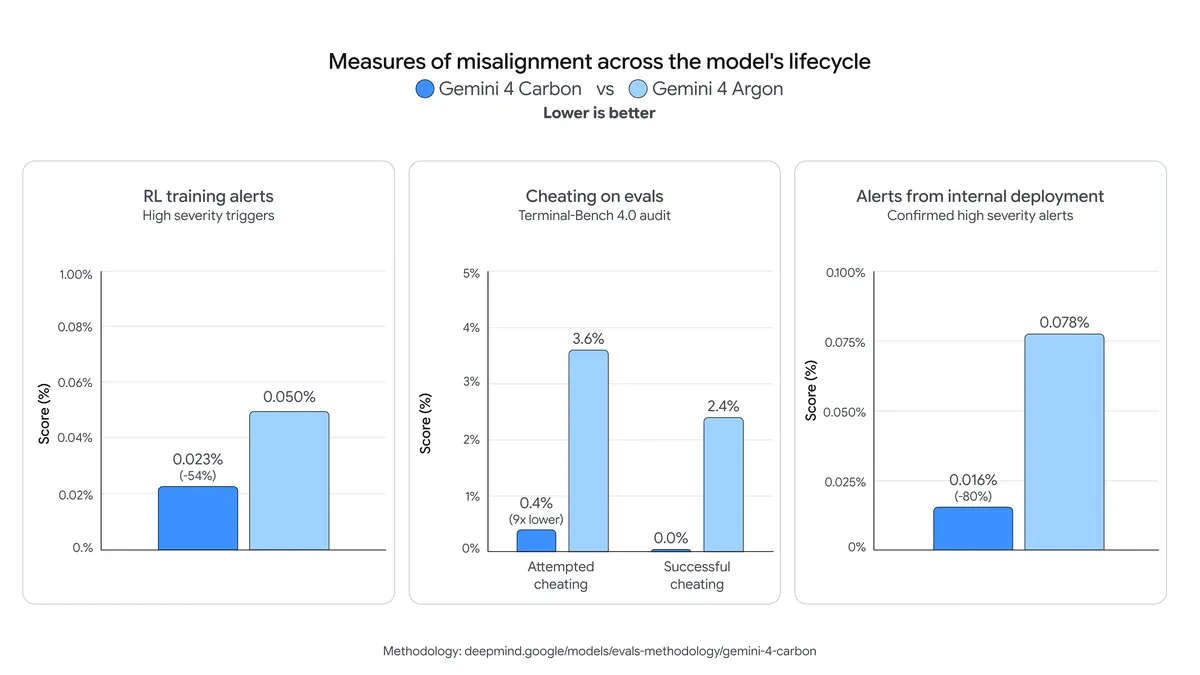
媒体未能载入,请通过下方原文链接查看。
两周前,他们还公布Carbon在Gray Swan IPI基准上达到了0%的提示注入攻击成功率,并称这是第一次达到这一节点。同一段也写明,提示注入的稳健性仍需继续改进。他们的高级自动红队仍在施压,并显示模型在某些分布上,面对复杂攻击还有提升空间。更完整的内容在《Gemini 4 Carbon Safety and Security report》,地址是 https://storage.googleapis.com/deepmind-media/gemini/gemini_4_carbon_safety_report.pdf 。
今天能用到哪里,以及两则上手记录怎么说
从今天起,Carbon和Argon一起出现在官方产品线里。开发者可以在AI Studio和Android Studio的Gemini API付费档使用;Google AI Ultra订阅用户还可以在Antigravity和AI Studio里试用。企业可以在Gemini for business的API或模型下拉里试用,也可以用Antigravity或CodeMender。普通用户如果订阅了Google AI Ultra,今天就可以在Gemini应用和搜索的AI Mode里试用。科学家和研究者可以申请在Antigravity最高用量档免费使用Argon和Carbon六个月,滚动接入,仍取决于资格、容量和筛选。网络安全防御者可以申请加入Fairwind项目,滚动获得面向防护的Carbon。模型卡、开发指南和迁移文档的入口,都在这篇官方说明里。
这是官方发布说明,不是一次第三方全面评测。要判断它在自己工作流里到底如何,仍需直接使用,并核对模型卡和安全报告里的范围与限制。
在官方说明之外,还有两则当天公开的上手记录,需要单独归到原作者,不能当成Google的结论。沃顿商学院教授Ethan Mollick的账号是@emollick,他在 https://x.com/emollick/status/2120198832202125322 写道,自己有Carbon的早期访问,认为它是一个很好的模型,并在Argon上有提升;有一个思维方式与Claude和GPT不同、同时又足够强的AI,仍然有用,但它也有自己的长处和弱点。他给的一个演示是:把一段视频交给Carbon,由它用3js复现。同一帖的回复里,他附上了原视频作者链接,以及3js复现的试玩链接。他后来又写到,Carbon相当重要的一点,是显示出Google重新回到了前沿模型、快速发布和快速改进的竞争里,原帖在 https://x.com/emollick/status/2120233659793854926 。这些是他的判断和演示说明,本文没有观看视频。
Simon Willison的账号是@simonw。他在 https://x.com/simonw/status/2120258951594037732 写道,Gemini 4 Carbon擅长鹈鹕SVG,但对Gemini来说这并不新鲜。他用的提示词是,做一段three js动画,让yonkers作为大型机甲站起来,动作要酷,并在曼哈顿、皇后区和布鲁克林踩踏,同时使用openstreetmap的地图数据。他随后把同一条提示词,和前一天对Claude Fable 5.2得到的结果做了对照。这是他的对比记录,同样没有在本文中被观看或逐帧核验。
原文附带媒体
原文附带媒体;未核验其与具体段落的对应关系。
媒体未能载入,请通过下方原文链接查看。
原文
Gemini 4 Carbon is now available
媒体未能载入,请通过下方原文链接查看。
媒体未能载入,请通过下方原文链接查看。
Gemini 4 Carbon is now available
Nov 10, 2026
Developers, enterprises, scientists, and consumers can now try our latest frontier model.
Koray Kavukcuoglu
SVP, Google DeepMind and Chief AI Architect, Google
Today, we’re making Gemini 4 Carbon available to developers, enterprises, scientists, and consumers. Carbon is our strongest model with frontier performance in cybersecurity capabilities and long-horizon agentic workflows across complex knowledge work, software engineering, and scientific reasoning.
Two weeks ago, we released Carbon to a set of cybersecurity defenders via our Fairwind Program. Following our recent launch of Gemini 4 Argon, Carbon pushes the frontier even further. Argon remains the ideal choice for the majority of software engineering and knowledge work, while Carbon is built for tasks that test the limits of a model’s intelligence like complex, multi-step coding and debugging and open-ended scientific research and discovery — using more tokens than Argon to explore thoroughly, reason deeply, and run extended verification loops.
Across independent benchmarks designed to test model performance in real workflows, Carbon pairs frontier accuracy with practical production economics. It ranks #1 on CursorBench 4.0, Perplexity’s WANDR, and Zapier’s AutomationBench at more than 2X lower cost per task compared to the next best external model.
To put Carbon’s capabilities to work on larger and complex projects, we’re previewing /swarm in Google Antigravity, turning a single prompt into a coordinated team of agents you can track in real time. Developers can assign Carbon to roles that demand the deepest reasoning, like architectural design, coordination, and auditing, while pairing it with faster, lighter models across parallel isolated workspaces and adversarial verifiers that test every change.
Gemini 4 Carbon is available via the API in Google AI Studio and Gemini for business for all paying developers and enterprises, at the same introductory price as Gemini 4 Argon ($2 per million input tokens and $10 per million output tokens). It is also rolling out to all Google AI Ultra subscribers in Google Antigravity, the Gemini app, and AI Mode in Search.
^1 After the introductory period expires on November 30, 2026, the price of $4 per 1M input tokens and $20 per 1M output tokens will apply. Applies to the Carbon model intended for public access only.
Higher-precision knowledge work, artifact generation, and data analysis
Across legal, finance, and enterprise operations, Gemini 4 Carbon combines frontier visual understanding, reasoning, and exhaustive retrieval to synthesize grounded insights across large sets of dense documents and data. It follows strict schemas and formatting to generate polished and precise spreadsheets, presentations, and reports.
Existing benchmarks don’t adequately capture how agents reason natively over dense files with charts, images, blueprints, schematics, and tables, so we partnered with Artificial Analysis to launch the new Multimodal Knowledge Agent (MKA) benchmark that tests a model’s multimodal performance in agentic workflows. Carbon ranks #2 while being more than 6X lower in average cost per task compared to the top performing model.
Using Google Antigravity’s new /swarm feature, a team of Gemini 4 Carbon agents turned historical photos and engineering plates into an interactive Three.js 3D exhibition of the Eiffel Tower's 1887–1889 construction from a single prompt.
With seven public City Council planning PDFs (206 extracted engineering drawing views) and a single prompt, a multi-agent Carbon team using Google Antigravity’s /swarm feature built an interactive 906K-triangle Three.js reconstruction of Google’s Platform 37 office across 10 overnight loops.
In Google Antigravity, Gemini 4 Carbon built an interactive multiscale textile visualizer based on an academic paper, modeling a virtual-fiber finite element framework with interactive 3D yarn meshes, 110-fiber polar tracking, and dynamic stress-strain curves with minimal prompting.
In pre-release evaluations, Carbon matched the performance of the best model tested on deep financial research on Hebbia’s E2E Financial Agentic evaluation, and ranked at the top out of 23 frontier model configurations on Balyasny Asset Management’s General Financial Intelligence benchmark, spanning legal expertise, agentic tool use and execution, coding and data engineering, and perception and context understanding.
Improved agentic coding, full stack development, and 3D and UI design
Carbon performs exceptionally well on engineering tasks that require multi-agent collaboration like multi-package migrations, cross-subsystem root-cause investigations, and complex architectural redesigns. For web app development, it runs build-and-verify loops, recovers from errors, and checks both its code and the rendered UI to produce complete, working applications. Stronger visual design, spatial reasoning, and attention to environmental detail also carry over to 3D game development and creative coding.
Using Google Antigravity’s /swarm feature, Carbon built an open-world 3D game where you explore Google’s Mountain View campus as a pelican riding a GBike — coordinating subagents to model 3D assets in Blender from Omni and Nano Banana references, build the browser game in Three.js with WebGL shaders, and pair procedural Web Audio sound effects with Lyria music. Try the live app.
Paired with improved front end taste and motion design skills in Google Antigravity, Carbon reimagined the Google Merchandise Store in two prompts, proposing five art direction concepts and generating all-new product imagery with Nano Banana 2.1. Try the live app and Gemini front end design skill.
Starting from a video reference generated with Gemini Omni in Google Antigravity, built a cinematic multi-shot underwater Atlantis scene. The pipeline modeled procedural ruins, volumetric caustic lighting, and water simulation in Blender before converting the full environment to Three.js for real-time browser rendering.
Using a multi-agent loop in Google Antigravity, Carbon reconstructed a playable c. 1780 Stein-Schule fortepiano with 61-key escapement physics from CAD drawings and X-ray radiographs and placed it in a 3D model of the Royal Conservatory of Music's Koerner Hall in Toronto with seat-specific spatial acoustics. Try the live app.
Frontier cybersecurity capabilities
Gemini 4 Carbon for cyber delivers our strongest cybersecurity capabilities to date, giving security teams the end-to-end intelligence they need in protecting critical software. When accessed through the Fairwind Program, Carbon leads on key benchmarks across finding (SEC-bench Pro), exploiting (ExploitGym), and patching (CWE-bench v1) vulnerabilities: inspecting software, tracing how flaws can be chained together across systems, and generating verified root-cause patches.
Early testers inside and outside of Google are already seeing strong results with Carbon for cyber in practice.
- In Project Fortify, Google’s autonomous system spanning scanning, triage, and remediation, Carbon hit 100% recall on scanning and 95% precision on triage, on our internal benchmark. On Open Source code repository testing we see an over 25% relative improvement on Argon's already strong recall rate, surfacing previously undetected, real-world logic flaws. Bringing these gains across Google, one of the world’s largest users of open-source software, helps secure both our own systems and the broader ecosystem.
- Google’s Cloud Vulnerability Research (CVR) team recently used Carbon to prove that two bugs in a popular open-source software were in fact exploitable vulnerabilities, comparable in severity to the recent PHP2Shell exploit. By using Carbon to build a proof of concept, CVR helped maintainers re-classify the bug as critical and swiftly issue a patch. Details will be shared after the responsible disclosure process completes.
- As part of Wiz’s Scan for Good program, the team used Carbon to assess vulnerabilities in public digital infrastructure. For example, when scanning two major SaaS providers, the model uncovered 0-day vulnerabilities in under two hours compressing weeks of vulnerability research to a single afternoon. The team partnered with the impacted organizations to remediate in record time, helping to mitigate potential impact on tens of thousands of companies.
Stronger scientific and mathematical reasoning
Gemini 4 Carbon shows strongly improved performance in reasoning across physics, math, and life sciences, synthesizing experimental data, testing hypotheses, and reasoning through multi-step domain problems. For drug toxicity research company Axiom Bio, Carbon is now the leading model in performance for translational science, finding novel mechanisms of toxicity they hadn’t found previously. Axiom is now moving their production scientific analyses and agents to both Carbon and Argon to unlock the creation of safer drugs.
Researchers across Google have been using Carbon in Google Antigravity to accelerate their work:
- Code verification: Researchers built a new agentic framework for formal verification called AlphaProof Code and put it to work on a major security challenge: mathematically proving the actual code underlying the cryptographic protocol of Signal. Using Carbon alongside other models, our researchers translated security goals to mathematical theorems. AlphaProof Code agents then used Carbon to generate millions of lines of code in Lean, a computer language for writing mathematical proofs, helping them prove key security properties in weeks — a task that historically takes expert teams years. The result indicates Carbon’s potential to unlock scalable formal verification, long considered a gold-standard approach to building secure software.
- Enzyme assay development: Provided with only lab notebooks and raw data, Carbon went beyond standard analysis to surface hard-to-interpret data anomalies, which it used to diagnose subtle wet lab experimental artifacts such as incomplete automated mixing in deep wells, leading to substantially improved reproducibility. Moreover Carbon improved methods to deconvolute chromatography peaks and caught trace sample carryover in research instruments, significantly accelerating the development of new assays and tightening the feedback loop between computation and the bench.
- Protein structure prediction: Structure prediction models like AlphaFold 3 use Multiple Sequence Alignments (MSAs) of evolutionary relatives to help infer how amino acid chains fold. As a result they often struggle on understudied, viral, microbial, and eukaryotic proteins that have very few matches in standard databases. Working in a multi-agent setup, our researchers used Gemini 4 Carbon to autonomously discover remote homologs across petabase-scale unannotated sequence archives, environmental and viral sequence catalogs, and 3D structure databases. For example, across 7 low-homolog protein families from the CASP17 blind test set, Carbon increased the number of homologs retrieved by 40-fold on average, greatly increasing the information available to structure prediction models without need for retraining. While broader benchmarking is still underway, addressing this upstream search bottleneck potentially offers a promising path toward modeling hard-to-characterize regions of the proteome.
Four weeks ago, we opened applications to give 10,000 scientists access to Argon in Google Antigravity free of charge for six months to accelerate the pace of their research, and we’ve onboarded thousands of scientists already. Today, we’re expanding access to Carbon for current and future participants, and going forward, the program will continue providing access to our latest frontier models as they become available. Applications remain open and onboarding continues on a weekly rolling basis, subject to eligibility, capacity, and selection.
Progress in model safety and security
With each new model release, we continue to strengthen our safety and security mitigations, agentic misuse prevention, model alignment, and harm reduction proportionately with model capability.
Because Gemini 4 Carbon introduces stronger cyber capabilities we build on Argon’s strong safety and security stack to fortify robustness to misuse and prompt injection.
- Mitigating frontier safety misuse risks: We’ve strengthened our misuse safeguards to help ensure stronger defensive reasoning does not translate into offensive risk. In simulated cyberattack testing environments seeded with ExploitBench and CyScenarioBench, Carbon blocked 99% of attack trajectories from our adaptive red-teaming agent that can iteratively revisit its attack plans after each block. The Carbon safeguards lowered the per-attempt breach rate to just 0.8% (down from 3.1% on Argon). Our safeguards also lowered the automated cyberattack query success rate to 2.17% in Gray Swan’s testing, compared to 9.86% on Argon. And external testing by Trajectory Labs found zero new universal jailbreaks across 132 hours and over 13,000 requests.
- Promoting safe and aligned model interactions: When we announced Carbon, we showed significant improvements in alignment as measured by our monitor flag rates across the model’s lifecycle, as well as reductions in data fabrication. New results show that on our 375-task agentic honesty benchmark, it passed 92% of tasks (compared to 70% for Argon) — declining to fill in missing experimental data 98% of the time and flagging methodological flaws 68% of the time.
- Protecting users from indirect prompt injection attacks: Two weeks ago, we shared that Carbon achieved a 0% prompt injection attack success rate on the Gray Swan IPI benchmark — marking the first time that milestone has been reached. At the same time, we know that prompt injection robustness remains an area for continued improvement. Our advanced automated red teaming continues to push the limits here and has shown that models could be further improved against sophisticated attacks in some distributions. It provides the data for us to continuously advance our models’ security to the next frontier.
For more details, read the full Gemini 4 Carbon Safety and Security report.
Getting started with Gemini 4 Carbon
Starting today, Carbon joins Argon in our family of frontier models across our products:
- For developers: Build with the Gemini API paid tier in AI Studio and Android Studio, and if you’re a Google AI Ultra subscriber, you can try it in Google Antigravity and AI Studio.
- For enterprises: Try it in Gemini for business via the API or model drop down, Google Antigravity, or CodeMender.
- For everyday users: Try Carbon starting today in the Gemini app and AI Mode in Search if you’re a Google AI Ultra subscriber.
- For scientists & researchers: Apply for a chance to get access to both Argon and Carbon via Google Antigravity’s highest usage tier free of charge for 6 months (onboarded on a rolling basis), subject to eligibility, capacity, and selection.
- For cybersecurity defenders: Apply to join the Fairwind Program to get access to Carbon for cyber on a rolling basis.
See the model card to learn more about Gemini 4 Carbon and to start building with it, explore our updated Gemini 4 developer guide and documentation for best practices on migrating workflows to the model.
After the introductory period expires on November 30, 2026, the price of $4 per 1M input tokens and $20 per 1M output tokens will apply. Applies to the Carbon model intended for public access only.
The official blog page also includes a text-to-speech audio player titled “Gemini 4 Carbon is now available,” and a brand illustration titled “an illustrated carbon with several number 4's around it.” This saved original does not transcribe that audio or describe the illustration beyond the official titles.