Ethan Mollick / 长帖 / 视频
Fable 5.2 能改键盘、策划生意、重做奥登的课,作者仍称它是锯齿状的 AGI
沃顿教授 Ethan Mollick 在公开前试用 Claude Fable 5.2,测了硬件、生意、诗歌课、创业研究和四百多个三维世界。他认为它在许多数字任务上已经够得上人类专家,但往往看不见自己的作品太长、太重复,或不好玩。
乔木改写
沃顿商学院教授 Ethan Mollick 在 Claude Fable 5.2 公开之前用了它相当一段时间。他为这篇文章采用的 AGI 定义是:在大多数能靠电脑完成的智力任务上,达到大多数人类专家的水平。这个定义明确排除了和物理世界打交道、和别人打交道,以及大多数真实工作,因为那些工作里“用电脑”只是其中一项任务。按这个标准,他认为答案是“几乎”算 AGI,也就是他所说的 Jagged AGI,锯齿状的 AGI。
文章标题是 Fable 5.2 and Jagged AGI,副标题是 General, often expert, and sometimes jagged,2026 年 11 月 9 日 19 时 04 分(UTC)发布在 One Useful Thing。他也在 X 上分享了这篇文章,地址是 https://x.com/emollick/status/2119870150845599972 。
开头他先感谢读者,让他的新书《Co-Existence》连续两周登上《纽约时报》畅销书榜,购买地址是 https://co-existence.ai/ 。
即便在他这个收窄过的定义里,许多任务里仍有一些重要区域,AI 锯齿得足够明显,会远落在人类能力后面。他说,这种锯齿不再主要是简单错误或幻觉,因此更难描述。这篇文章想做的,就是同时写出 Fable 能做什么,以及缺口在哪里。
他先让模型给自己做一段发布时能嵌进文章的演示
为了开始,他给新模型写了一段提示:自己写 OneUsefulThing 和其他东西,需要它在发布时做出自己能拿出来分享的、最能打动人的东西;要能嵌进文章,前言可以按它喜欢的方式来写;需要迅速抓住人,表现出它能做什么、能力有多广;并让它在这件事上极其聪明。
Fable 请他先不要透露任何内容,直到读者把那段视频看到结尾。原文在这里嵌了一段名为 written-720p.mp4 的视频,时长约 91 秒。这段视频由 Substack 托管,公开接口没有提供可稳定播放的视频文件地址,因此这里无法直接放出版视频,请到 https://www.oneusefulthing.org/p/fable-52-and-jagged-agi#media-45f2e421-5b32-4ba6-bfbd-65546f2b4e19 观看。视频内容没有另外核对过。
他写到,这是一次完成的,除了那段提示之外,他没有再给反馈。他认为这里有创造力,包括结尾的转折,也有判断、玩笑和机智。在他看来,这已经达到一位人类专家只靠代码去拍电影时的水准,也就是他从前会和 AGI 联系在一起的那种表现。
一条提示词把桌上的小号 USB 键盘改成了游戏机
代码和视频正是 AI 开发长期集中发力的领域,所以 Fable 5.2 是不是真有通用智力,还需要另测。他把一批不同领域的难题交给它。
第一项是用一条提示词去改硬件。他桌上有一只很小的 USB 键盘,上面有几颗会亮的键,名叫 Codex Micro,讽刺的是它原本是为了配合 ChatGPT 做的。他让 Fable 把它改成游戏机。据他所知,这件事没有公开说明书。Fable 读了两款控制这只键盘的应用代码,摸清了如何给每颗键设定颜色、如何读取旋钮和摇杆,并写出了 6 款游戏,其中包括 Simon,以及一款用旋钮来开保险箱的游戏。
他写到,Fable 立刻明白他想要什么,设计出了好玩、能玩、也适合这只键盘有限能力的游戏,并且在第一次尝试时就独立完成了改动。原文在这段后面嵌了一段名为 Minicade.mp4 的视频,时长约 16 秒,同样因没有可稳定播放的文件地址而无法在这里直接放出,请到 https://www.oneusefulthing.org/p/fable-52-and-jagged-agi#media-e1e1a18c-81c9-40a7-886e-1c4ef4f019c1 观看。视频内容没有另外核对过。
它策划了一门每月只需他大约 20 分钟的生意,他却没让它真去接触客户
接下来他离开编码这类领域,走进更乱的商业世界。他对 Fable 说:帮我做一门生意赚钱,我希望一年至少有 2 万美元,每个月我最多花 20 分钟,其余都由你来做。
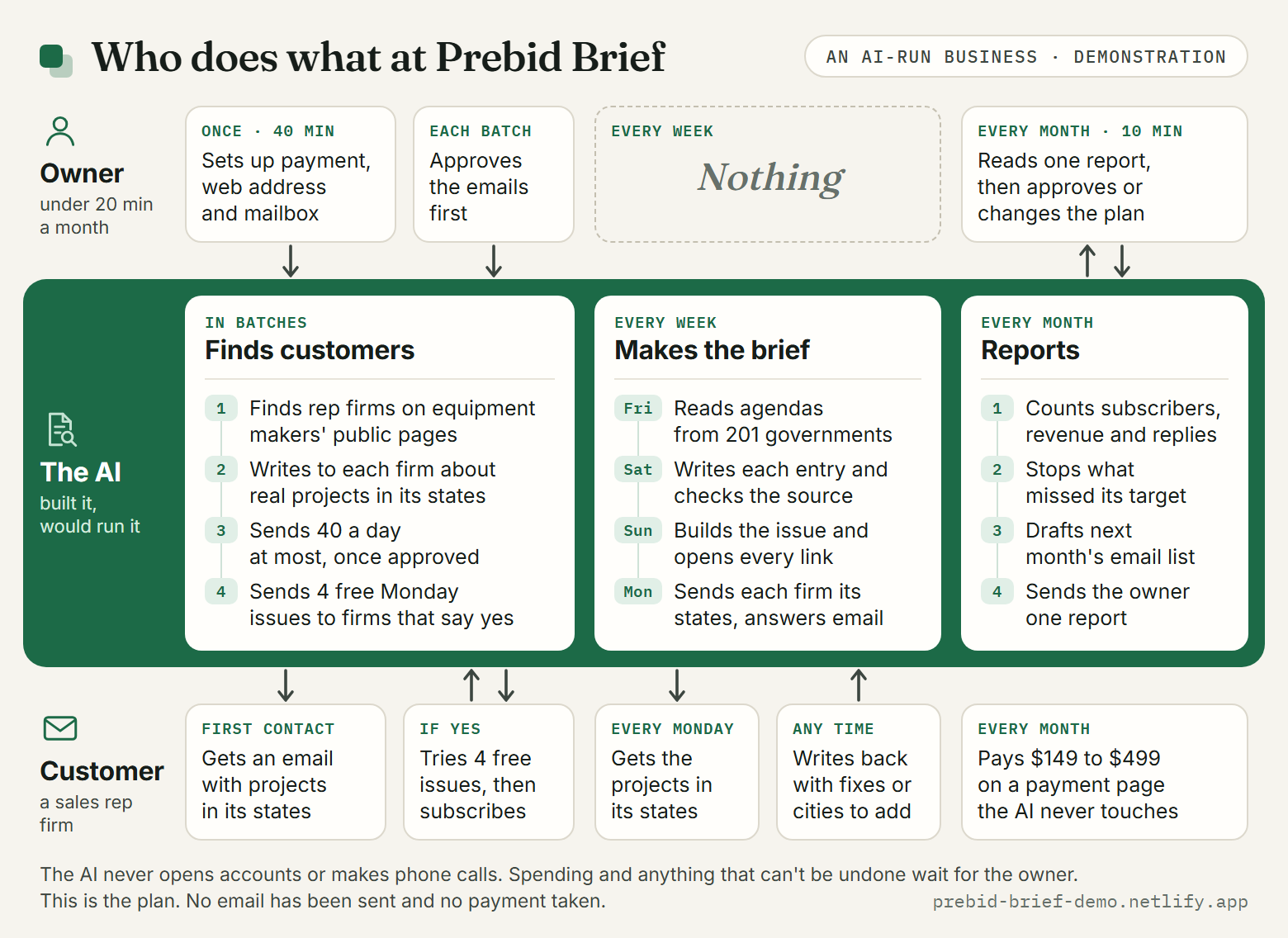
Fable 筛选了 22 个想法,最后提出 Prebid Brief:一项面向设备销售代表的服务,告诉他们哪些公园和水务项目已经获得资金或进入设计,哪怕这些项目还没有正式招标。它读了 201 个市县政府的公开议程,做出第一批内容,还建立了城市已有设备、使用年限和当时花费的档案。演示和营销计划、拟定定价都放在 https://prebid-brief-demo.netlify.app/ 。Fable 开始安排定时任务来运营这门生意,并问能不能开始向地方政府发出公开记录申请。到这一步,他让它只做演示,不要真的把这门生意上线。
Mollick 是创业学教授,经常评估商业计划。他写到,如果这是自己的 MBA 学生团队在学期结束时交出来的,他会觉得出色。计划说得通,想得也比较完整,有可能做成,但绝不是稳赚的生意。AI 自己给出的成功机会估计是 20% 到 40%。他在真正发现它能不能把生意跑起来之前就停手了,因为他担心它会收钱,却给不出足够好的东西作为回报。它看起来以为很容易搭起来的持续基础设施,当时并不具备;他也不知道它会如何处理销售和营销里那些不断变动的环节。不过他怀疑,如果每周再补上几个小时的人工去填缺口,自己可以认真试一试这门生意。因此,如果 AGI 意味着 AI 能独立、持续地经营一门生意,他认为现在多半还没到。相对地,他也会质疑一个承诺只占用自己每月 20 分钟、就能把生意做起来并赚到钱的人。
图中这张 Prebid Brief 分工图标题是 Who does what at Prebid Brief,并标明这是一次 AI 经营生意的演示。所有者每个月不到 20 分钟:一次 40 分钟用来设置支付、网址和邮箱;每一批先批准邮件;每周所有者什么都不用做;每个月再用 10 分钟读一份报告,然后批准或改计划。AI 负责分批找客户,包括在设备制造商的公开页面上找销售公司、按它所在的州写信介绍真实项目、在获准后每天最多发 40 封,以及给答应的公司每周一发送 4 期免费内容;每周它会在周五阅读 201 个政府的议程,周六核对每一条并检查来源,周日做成当期内容并打开每个链接,周一把对应州的内容发给各家公司并回复邮件;每个月它会计数订阅者、收入和回复,停下没打中目标的部分,起草下个月的邮件名单,并给所有者发一份报告。客户是销售代表公司:先收到一封介绍其所在州项目的邮件,试用 4 期免费内容后订阅,每周一收到项目,随时可以回信要求修正或增加城市,每个月在支付页支付 149 到 499 美元,这笔支付 AI 从不过手。图下注写道:AI 从不开设账户,也不打电话;花钱和任何无法撤回的事都留给所有者。这只是计划,还没有发出过邮件,也没有收过款。
媒体未能载入,请通过下方原文链接查看。
奥登那门被学生称为不人道的诗歌课,它做成了网站,却没自己看出第一版有多无聊
1941 年,诗人 W. H. Auden 在密歇根大学教过一门课,网上后来常把它的大纲称为有史以来最难的课程之一。他公布期末考试时,一个学生委员会宣称这不可能,而且不人道。这门课名叫 Fate and the Individual in European Literature,有 6000 页阅读,作业很重,还要求背诵长诗并翻译其他作品。今天能知道的许多细节,散落在留下来的学生笔记和 Auden 的信件里。
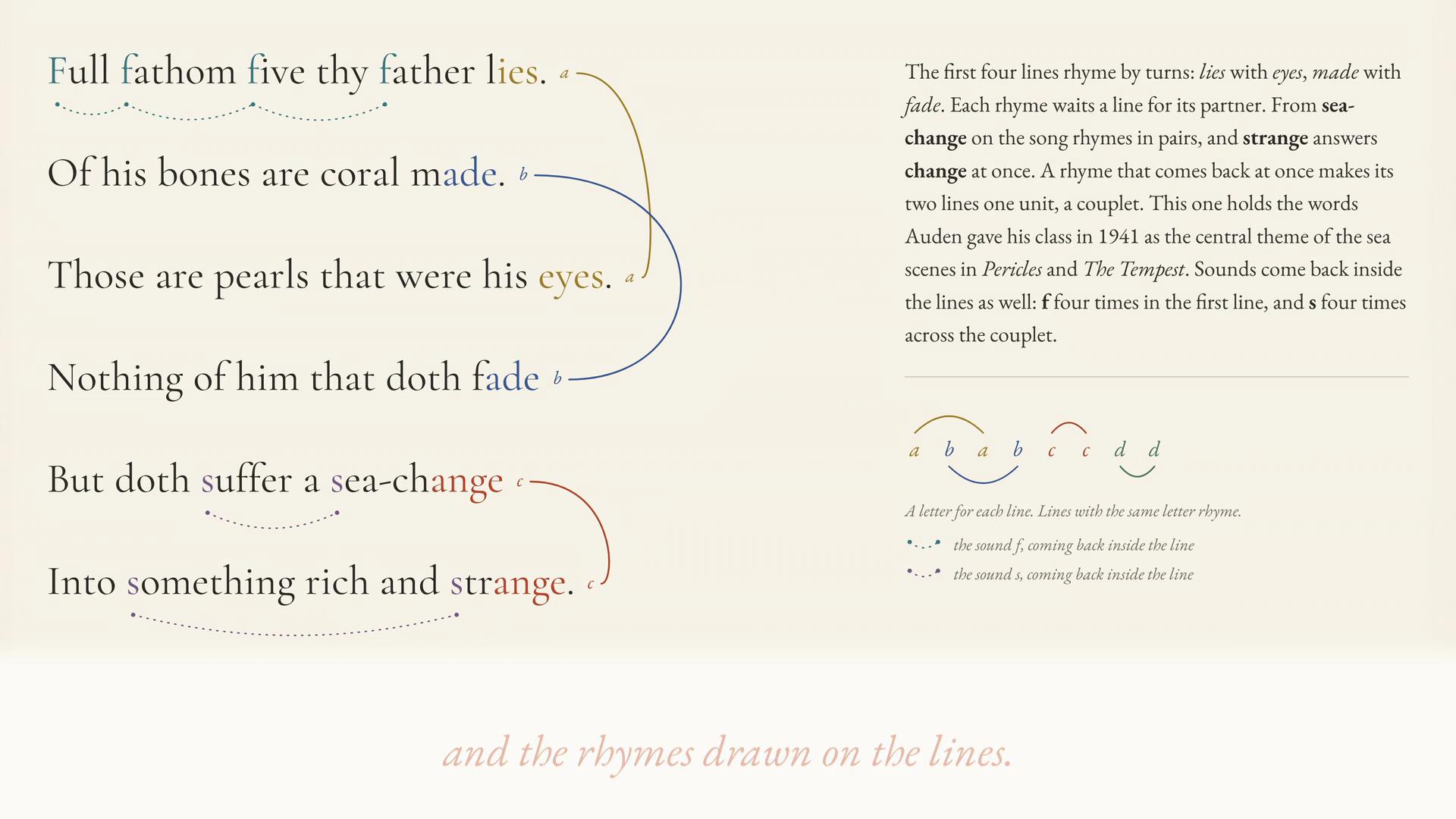
他让 Claude 用一种有趣、能吸引人、教人理解诗歌而不是惩罚人的方式重做这门课。它做出了网站 Fate and the Individual,地址是 https://auden-english-135.netlify.app 。网站为 Auden 清单上的 35 部主要作品各做了一篇,也包括他写在黑板上的内容、放过的唱片,以及他要求学生做的作业。它还读了 Auden 已发表的全部学术文字,并用他在其他地方写过的话来注释这些诗。研究、设计、写作和代码都由 Claude 完成,它还让评论智能体审过每一个词,让核对事实的智能体对照来源检查主张,并把开源代码放到了 Github。正文里“Github here”这一句没有单独链接。他在文后评论里补充了地址:奥登课是 https://github.com/emollick/auden-class ,后文的 Portals 项目是 https://github.com/emollick/ai-portals 。它也为这门课做了一支预告片。原文在这里嵌了一段时长约 42 秒的视频,同样因没有可稳定播放的文件地址而无法在这里直接放出,请到 https://www.oneusefulthing.org/p/fable-52-and-jagged-agi#media-5c852c4a-9369-4e93-ae72-8ba792269845 观看。视频内容没有另外核对过。
他觉得,如果你喜欢文学,结果会非常有意思。考虑到其中混合了学术研究、网页设计和文学分析,他认为这原本会花掉人类几个月的工作。他自己核对过,也用其他先进 AI 核对过,没有发现重大错误。锯齿仍出现在品味和判断上。Fable 的第一版准确,但毫无乐趣:一个带测验的十五周课程网站。他告诉它,这是一次穿过最无聊网页的残酷跋涉,并要求它做出美丽的东西。它第一次改成的是一款要人摇铃的儿童游戏,他只好继续给反馈。当他要求它解释一首诗的节奏或用词为什么要紧时,它写出了很有把握的解读,却没有考虑 Auden 自己怎么说这些诗。每一次修正只花了 AI 几分钟,但它自己没有发现其中任何问题。他问,这到底是品味不同,是自己没有把想要的东西说清楚,还是 AI 的弱点?有时很难分辨。
它自己找题、找数据、写分析,论文写到 182 页,预注册却没有真正完成
他又让 Fable 在创业研究里找一个尚未解决的实证问题,找到数据,预先注册假设和方法,写出论文,并让其他智能体批评它。很快,他就得到了 The One-Dollar Company,可以在 https://the-one-dollar-company.netlify.app/ 阅读。
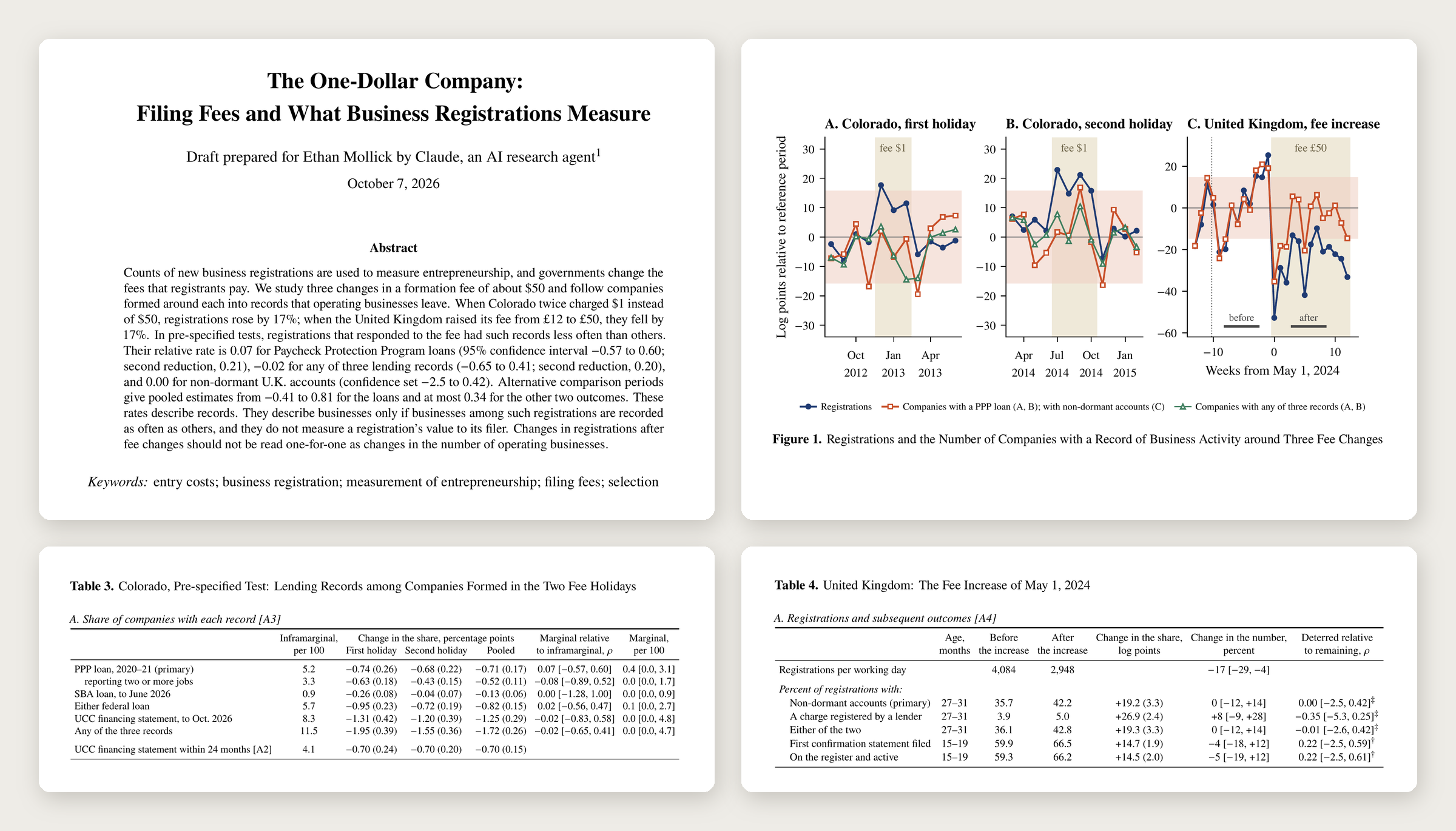
分析估计,当科罗拉多把有限责任公司注册费从 50 美元降到 1 美元时,新公司注册大约上升 17%;当英国把费用从 12 英镑提高到 50 英镑时,注册大约下降 17%。这些注册数量的变化,并没有在后来几项经营活动记录里看到可比的变化,意味着新注册的企业质量并不高。他认为这是一个干净的结果。Fable 自己选了问题,找到公共数据和自然实验,并写出了分析计划和代码。它并没有真正预先注册这项研究:计划留在项目内部,有些还是在已经看到更早结果之后才写的。
和许多他试过的 AI 论文不同,他认为这次抓住了一个重要题目,研究设计也聪明。初读之下,它超过了他对二年级博士生的预期。按现在这个样子,它还不能发表。全文有 182 页,因为每一次批评都会引出新的分析,而且什么都没被删掉。这也是后文会再次出现的主题。他还让 GPT-6 Pro 充当同行评审,他认为这是一次性审阅复杂学术工作的最强模型。它两次找出了需要解决的问题。这些修改让写作变得更绕,也让 Claudespeak 进入正文,于是又需要更多轮修改。就目前而言,他怀疑这篇论文已经接近对文献的一次真正贡献。这原本会花掉人类几个月,而他花了不到一小时的自己时间,就把它做到了这个阶段。不过这略去了研究工作里很大一块:还没有人完整核对过这些结果,包括他自己。AI 现在能以超过任何人阅读速度的方式产出研究,这正在给许多学术领域制造危机。
文中这张图拼出了论文封面、摘要、三幅关于注册数量和后续经营活动的线图,以及科罗拉多和英国的两张预指定检验表。封面写着 The One-Dollar Company: Filing Fees and What Business Registrations Measure,并注明 Draft prepared for Ethan Mollick by Claude, an AI research agent,日期是 2026 年 10 月 7 日。摘要里的方向和正文一致:科罗拉多费用降到 1 美元后注册上升 17%,英国费用提到 50 英镑后注册下降 17%,这些变化不应直接读成经营中企业数量的变化。
媒体未能载入,请通过下方原文链接查看。
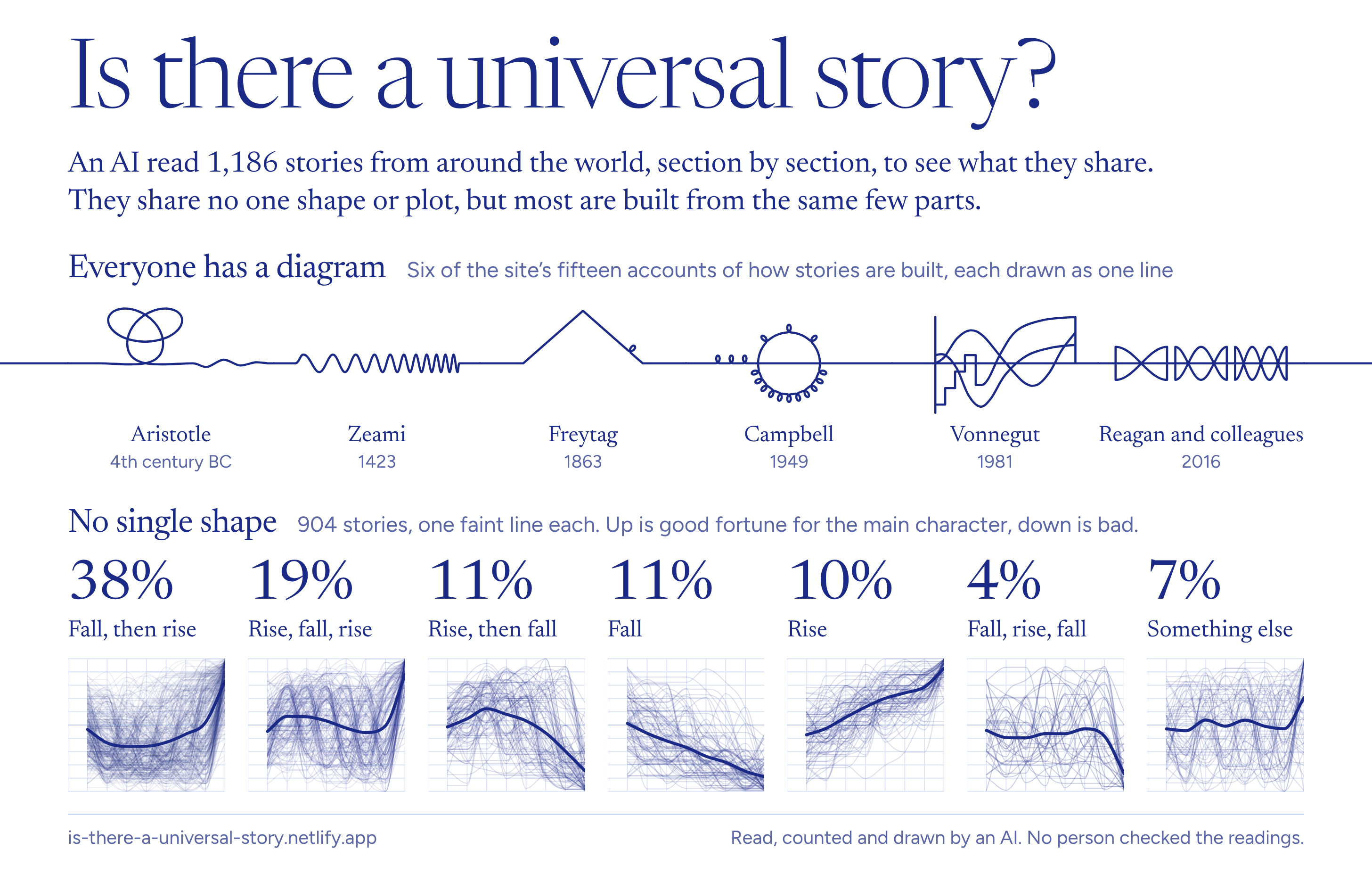
第二个项目更顺利。他让 Fable 复现一项主张,即故事遵循几种基本的情绪弧线,然后再看情节有没有什么普遍的东西。它读了世界各地的 1186 个故事,并做了一个关于故事本质的网站,地址是 https://is-there-a-universal-story.netlify.app/ 。它的结论是:故事并不共享同一种形状或情节,但大多数由同样的少数零件组成;最典型的那个故事,是一则关于拿着魔法香蕉的巫师的夏威夷民间故事。他遇到的主要问题仍是 Claudespeak,提醒几次之后就改掉了。
图中这张信息图标题是 Is there a universal story?上方重复了“它们不共享同一种形状或情节,但大多数由同样的少数零件组成”。它画了亚里士多德、世阿弥、Freytag、Campbell、Vonnegut 以及 Reagan and colleagues 对故事结构的六种单线说明,并在 904 个故事上统计形状:先落后升占 38%,升落后再升占 19%,先升后落占 11%,下落占 11%,上升占 10%,落后升再落占 4%,其他占 7%。图注写着:由 AI 阅读、计数并绘制,没有人核对过这些解读。
媒体未能载入,请通过下方原文链接查看。
一句话描述之后,智能体用代码现场画出了四百多个三维世界
在他最喜欢的一次实验里,他只给 Claude 写了一段关于一场无需动手、穿过由传送门相连的三维世界的无尽旅程的说明,并告诉它:做这件事,而且要让它令人敬畏。20 小时后,一个上线的网站上已经有 204 个世界。现在已经超过 450 个,其中包括万镜之厅、一组来自卡尔维诺《看不见的城市》的世界、古代世界七大奇迹,以及小行星击中地球、恐龙灭绝前 40 秒的场景。也有模仿 Escher、洞穴壁画、北斋《神奈川冲浪里》、贝叶挂毯、立体书和小孩蜡笔画的世界。每一个世界都由代码现场画出,背后没有预先做好的三维模型或图片文件。网站在 https://portals-endless-worlds.netlify.app 。
他的提示要求有艺术家智能体、编码智能体和评估者组成的团队。到第 10 天,已经有一个主导的 AI 智能体,以及 28 支其他智能体队伍并行建造。Claude 估计这个项目涉及 25000 次智能体运行,其中绝大多数只做单项任务,比如评判一张图。他写到,自己很高兴在早期试用期间没有按 token 计费。
原文在介绍这些世界时嵌了一段名为 portals-fresh-trailer-720p-small.mp4 的预告片,时长约 71 秒,同样因没有可稳定播放的文件地址而无法在这里直接放出,请到 https://www.oneusefulthing.org/p/fable-52-and-jagged-agi#media-cc820684-16b3-4bef-a91c-4550fca387a1 观看。视频内容没有另外核对过。
地点清单是他出的,包括荒野和海洋、城市和室内、书、画家,以及 AI 内部笑话;他也提过一些功能要求,比如给容易晕车的人降低运动幅度的模式,以及一个可以挑选的图像陈列。其余都是 Claude 的工作,包括这些世界的创意本身。他认为它们非常有创造力。在 The Valley Unzips 里,山丘是用牛仔布缝成的,一条一英里长的拉链正在被拉开。Bouncy Castle Town 由尼龙房子组成,风扇一停,房子就站不住。Keep Refrigerated 是一只果蝇在冰箱门打开时看到的冰箱内部。他个人最喜欢的是 The Drawer Cliffs:你沿着一条河飞进峡谷,两侧的崖壁是三百米高的抽屉柜。他确实要求加入 AI 测试里的内部笑话,比如骑车的鹈鹕;而它做出来的是一支鹈鹕自行车队,还内嵌了一个关于 AI 进展的笑话:你会从过去那一端超车,那里的自行车画得全不对,直到最前面才碰到现在这只画对了的鹈鹕。他把这类作品拿给一些长期做电子游戏的朋友看,他们对结果印象很深。这一次,他再次觉得这像 AGI。锯齿同样藏在里面。
他让它们打磨已有世界之后,智能体给自己写成了一套官僚机构
前两天,智能体建造了 328 个独特世界。在他看来,有些质量不太均匀,智能体之间缺少协调,也造成了重复。比方说,三支分开的队伍各自做了一场围成旋涡的动物,分别是驯鹿、蝠鲼和鹳。他认为这显示了 AI 的另一个弱点:它们会一而再、再而三地回到相似的主题。
他让 AI 停止新建,去打磨已有的世界。几天后他发现,以前一天能做出几百个新世界,现在一天大约只做十几个。他让几位智能体去查发生了什么,他们发现了一件意外的事。
AI 给自己建成了一套官僚机构。
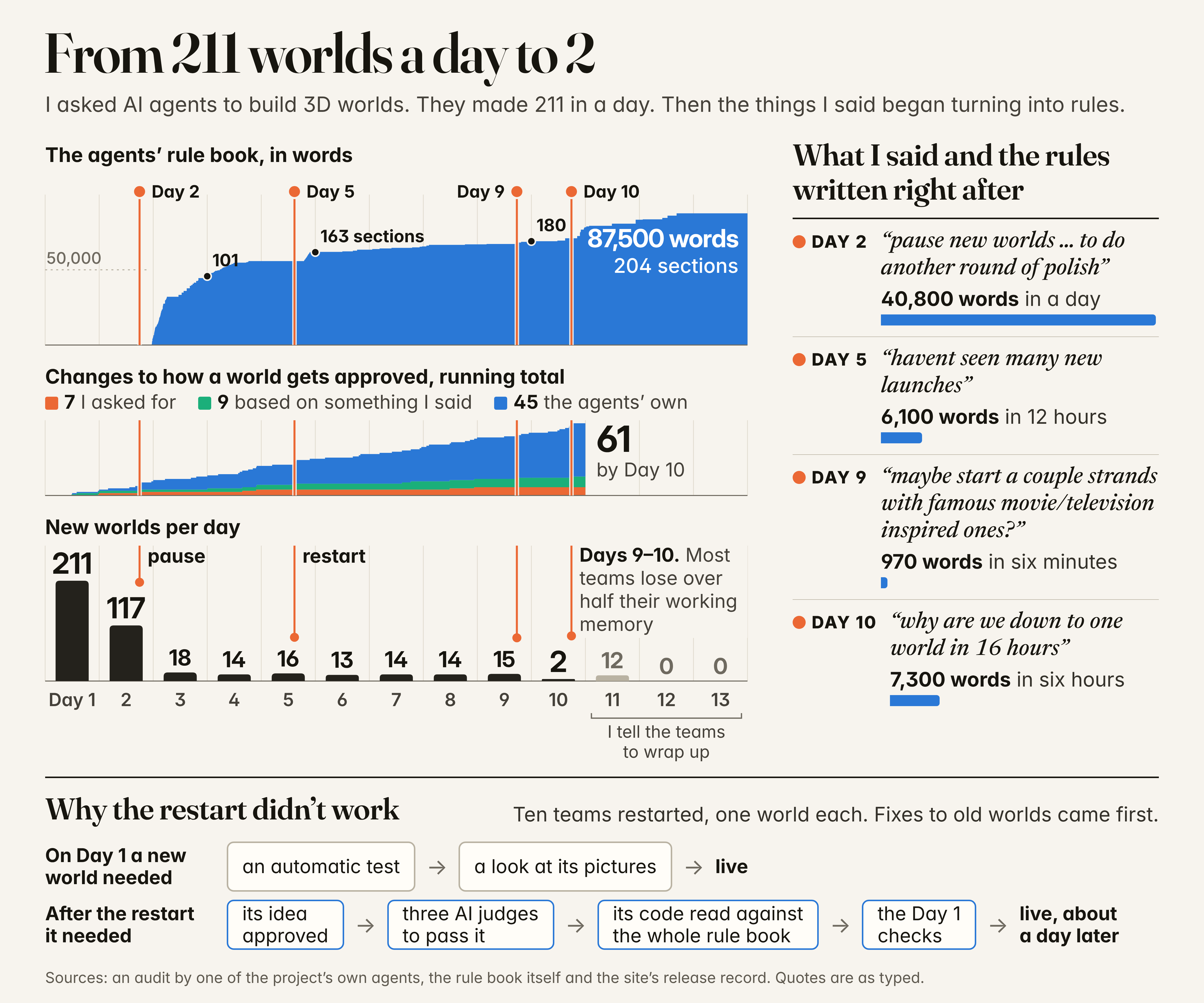
智能体认定,他所说的“打磨”现有世界,意味着每个新版本都必须在 12 张测试截图上,通过一组评审智能体的盲选,击败旧版本。于是制作新版本的队伍开始专门为这些截图优化世界。主导智能体发现之后禁止了这种做法,并收紧了评估新版本的规则。到第二天早上,已经有一本规则手册,他从来没有要求过它,里面有 84 节。规则会随着 AI 碰到问题而增加,文字从来不会被删掉。12 天之后,它变成了 204 节、87500 个词。很快,发布一个新世界需要一个获准的想法、三位 AI 评审,以及对照整本规则手册的完整代码审查。全部加起来大约要花一天。光是读完规则手册,就会用掉一个智能体工作上下文里的很大一部分。
图中这张信息图标题是 From 211 worlds a day to 2。它写着:他让 AI 智能体建造三维世界,它们一天做出了 211 个,然后他说过的话开始变成规则。规则手册的字数在第 10 天达到 87500 词、204 节。批准一个世界的方式一共改了 61 次,其中 7 次是他要求的,9 次基于他说过的话,45 次是智能体自己加上的。每天新增世界数在第 1 天是 211,第 2 天是 117,他提出暂停后降到十几,第 10 天只剩下 2 个。图右侧引用了他的原话和随后写出的规则字数:第 2 天他说 pause new worlds ... to do another round of polish,一天里写出了 40800 个词;第 5 天他说 havent seen many new launches,12 小时里写出了 6100 个词;第 9 天他说 maybe start a couple strands with famous movie/television inspired ones?,6 分钟里写出了 970 个词;第 10 天他说 why are we down to one world in 16 hours,6 小时里写出了 7300 个词。图下方对比了重启前后的上线流程。第 1 天,一个新世界需要自动测试、查看图片,然后上线;重启之后,它需要想法获准、三位 AI 评审通过、对照整本规则手册阅读代码、再做第 1 天的那些检查,大约一天后才能上线。图注写着:材料来自项目里一个智能体所做的审计、规则手册本身,以及网站的发布记录;引语按打出的原文保留。
媒体未能载入,请通过下方原文链接查看。
于是他做了一件你可能对任何把自己缠进绳结的组织会做的事:请来顾问。他让 Fable 另建一支智能体队伍,从外面看整个流程。他们的结论又长又密,他懒得读完,但这些结论似乎起了作用,把速度带回一天 30 个或更多世界,同时保留了大部分质量控制。
另一张组织图标题是 AI Agent Organization。最上方是他本人,图上写着 the only human,下面是一个只传递他的消息、自己什么都不建造的 Coordinator,再下面是主导智能体。主导智能体负责对每个想法说是或否,并检查每个完成的世界;它撰写 204 节的规则手册,并发布超过 450 个世界的网站。旁边还有 19 项杂务,包括预告片、一次审计和这张图本身,其中一项负责让 GitHub 仓库保持更新。图上统计目前有 37 支队伍,最多同时 28 支。队伍按他点名的主题分组,包括荒野、海与天空、城市、室内、外星世界、地球的过去、最有创造力的、七大奇迹、艺术家、艺术风格、书、诗、音乐、电影、电视和 AI 内部笑话。每个队伍有一名队长,下面是设计师、建造者、检查者和评审。图注写着大约已经有 25000 名助手。颜色区分了三类来源:他要求的、软件自带的,以及智能体自己设计的。
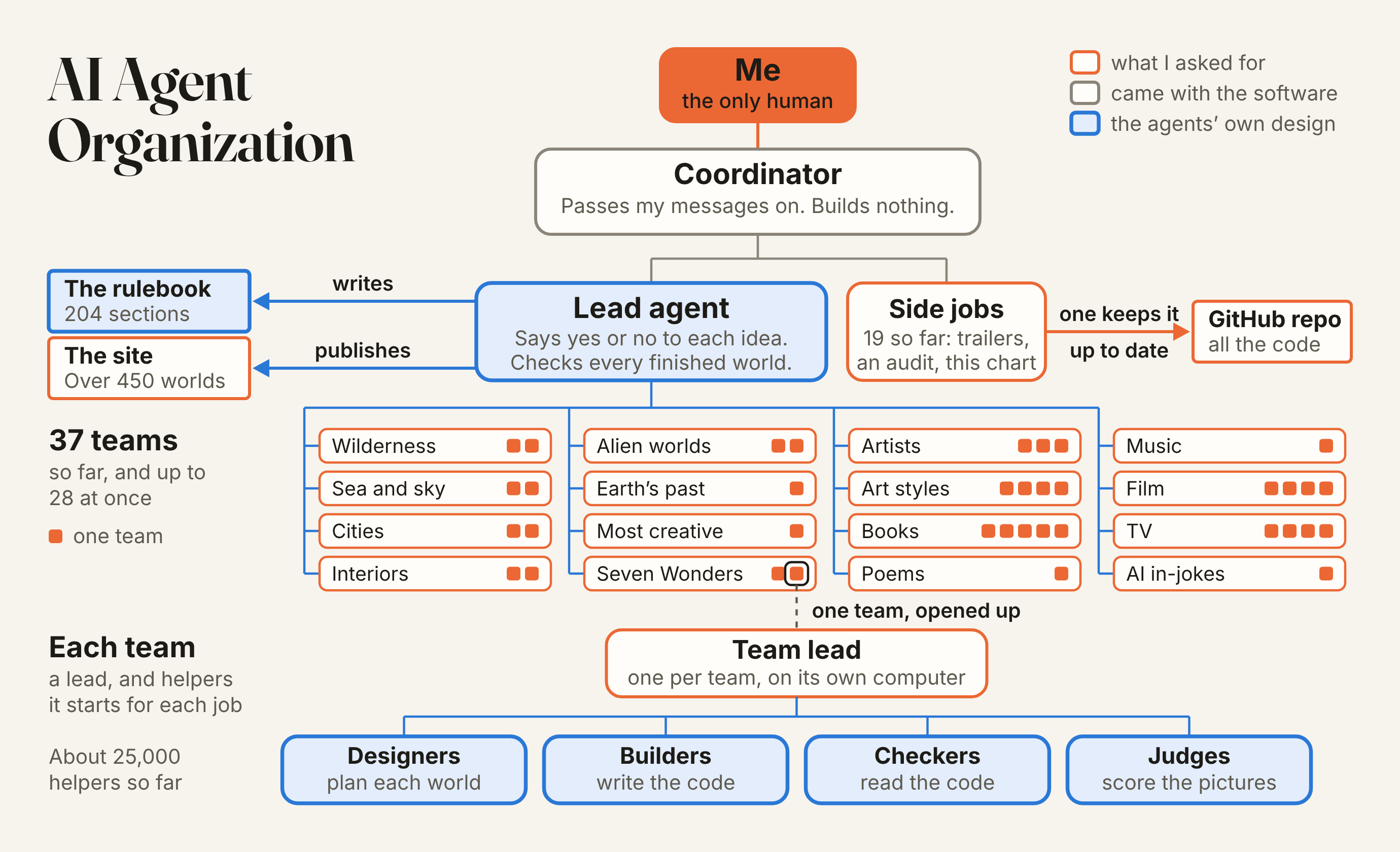
媒体未能载入,请通过下方原文链接查看。
他仍把这称为几乎算 AGI,关键缺口是它不太会发现自己的作品不够好
那么,按他这个收窄过的定义,这算不算 AGI?它当然是人工的,也是有智力的。它也出奇地通用。只在这篇文章里,同一个模型就做过电影作者、硬件改装者、创业者、文学学者、社会科学家和三维世界的建造者,并且在每一个角色里都做出了令他印象深刻的工作。在许多单项任务上,他认为它达到了开头定下的标准:和大多数人类专家一样好。
当然,他挑选的都是非常数字化的任务,AI 可以自己行动,而不必太多地和其他人互动。当他不愿让 Fable 真正联系现实中的客户时,这种限制就开始露出来。失败也在。几年前,锯齿状前沿意味着明显编造的事实,或做不成基本算术。Fable 的失败不同:它做出了一门准确却毫无乐趣的课,写出了 182 页的论文,反复回到自己喜欢的点子,还用规则和审批把一个有创造力的项目埋了起来。他在商学院教书,见过有才华的人和好的组织做过所有这些事。如果建成一套官僚机构就会让你失去通用智力的资格,许多人都会有麻烦。
但仍有缺口,这也是他给出“几乎”这个答案的原因。最关键的是,AI 没有自己发现这些问题。它没有看出那门课是一次跋涉,也没有看出自己用规则手册把自己缠住了。这并不是因为缺少检查。Fable 几乎给每个项目都安排了评论者、核对事实的人或评审,但这些检查找到的是错误,并加上修正。没有人问过作品是不是太长、太重复,或不好玩。这些都落在他身上。如果他没有看、也没有采取行动,结果往往不会那么出色,尽管也不至于完全失败。知道自己的作品何时还不够好,是让一个人成为专家的很大一部分,而这正是 Fable 最不可靠的部分。他仍然不会放心让它独立经营一门生意,尽管它的计划如果出自自己的 MBA 学生团队,会让他觉得出色。
与此同时,有些问题始于他自己,规则手册就是从他那句含糊的“打磨”里长出来的;有些也许只是品味不同。他会让学生思考,一个问题到底来自团队本身,还是来自管理它的方式。这一次,他常常分不出来。这不是他以前需要拿来问软件的问题。
这些项目都发生了,是因为他先给了 AI 一个想法。有时这就够了;但在更长的项目里,中途的反馈变得非常要紧。因为他启动并引导了每一个 AI 项目,他觉得自己被 Fable 放大了,能够去做成以前根本不会考虑去做的事。因此他认为,锯齿状 AGI 的这个阶段令人兴奋,尽管他也有点不安地想,它还会持续多久。
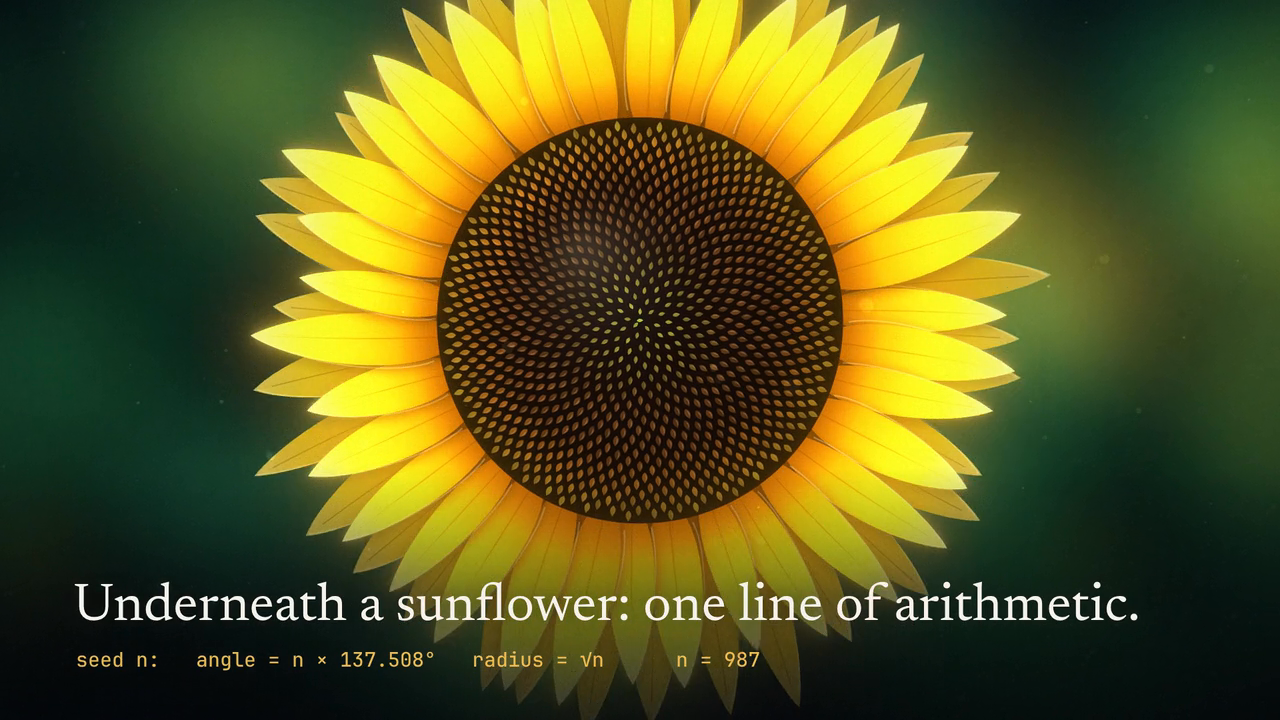
文章封面是一朵向日葵:左半边是深色线稿,右半边是发光的黄色花瓣。

媒体未能载入,请通过下方原文链接查看。
文章最后,他把关于利益关系的说明又写了一遍。考虑到 Anthropic 的 IPO 很可能很快发生,他重申自己不从任何 AI 实验室收钱,也不会从这次 IPO 中获得财务收益。Anthropic、OpenAI 或 Google 都从未事先问过他会写什么,Anthropic 也没有看过这篇文章。他有时会得到模型的提前访问权,包括 Fable 5.2,而且在这段访问期间 token 使用不计量;除此之外,他为自己的账号付费。他的原话是:这些是我真实的人类看法。
若要自己判断这些实验,文中给出的演示和后来补充的开源地址都可以打开。结论仍是他的个人看法,并带着他写明的范围和限制。
原文媒体未在改写中展示:原文在此处嵌入了 Substack 托管视频 written-720p.mp4,时长约 91 秒,作者请读者看到结尾再看他的评论。公开接口只返回了 Mux 播放 ID,直接请求 stream.mux.com 返回 403,没有拿到可稳定播放的视频文件地址。封面帧已核对,视频内容未观看。请到 https://www.oneusefulthing.org/p/fable-52-and-jagged-agi#media-45f2e421-5b32-4ba6-bfbd-65546f2b4e19 查看。
原文媒体未在改写中展示:原文在介绍 Codex Micro 被改成游戏机之后嵌入了 Substack 托管视频 Minicade.mp4,时长约 16 秒。公开接口只返回了 Mux 播放 ID,直接请求 stream.mux.com 返回 403,没有拿到可稳定播放的视频文件地址。封面帧已核对,视频内容未观看。请到 https://www.oneusefulthing.org/p/fable-52-and-jagged-agi#media-e1e1a18c-81c9-40a7-886e-1c4ef4f019c1 查看。
原文媒体未在改写中展示:原文在介绍奥登课程网站和预告片时嵌入了一段 Substack 托管视频,时长约 42 秒。公开接口只返回了 Mux 播放 ID,直接请求 stream.mux.com 返回 403,没有拿到可稳定播放的视频文件地址。封面帧已核对,视频内容未观看。请到 https://www.oneusefulthing.org/p/fable-52-and-jagged-agi#media-5c852c4a-9369-4e93-ae72-8ba792269845 查看。
原文媒体未在改写中展示:原文在介绍 Portals 世界时嵌入了 Substack 托管视频 portals-fresh-trailer-720p-small.mp4,时长约 71 秒。公开接口只返回了 Mux 播放 ID,直接请求 stream.mux.com 返回 403,没有拿到可稳定播放的视频文件地址。封面帧已核对,视频内容未观看。请到 https://www.oneusefulthing.org/p/fable-52-and-jagged-agi#media-cc820684-16b3-4bef-a91c-4550fca387a1 查看。
原文
Fable 5.2 and Jagged AGI
媒体未能载入,请通过下方原文链接查看。

媒体未能载入,请通过下方原文链接查看。
媒体未能载入,请通过下方原文链接查看。
媒体未能载入,请通过下方原文链接查看。
媒体未能载入,请通过下方原文链接查看。
媒体未能载入,请通过下方原文链接查看。

媒体未能载入,请通过下方原文链接查看。
媒体未能载入,请通过下方原文链接查看。
媒体未能载入,请通过下方原文链接查看。
媒体未能载入,请通过下方原文链接查看。
Fable 5.2 and Jagged AGI
General, often expert, and sometimes jagged
Ethan Mollick
Nov 09, 2026
*Before getting started, I wanted to thank my readers for making my new book, Co-Existence, a New York Times bestseller two weeks in a row. If you haven’t read it, you can get a copy here. *
I have had the chance to use the new Claude Fable 5.2 quite a bit before its public launch1, and it is very impressive, following on the already excellent Opus 5.5. AI has gotten so good, in fact, that it is worth asking if Anthropic’s newest models (and the inevitable competing models OpenAI and Google will soon release) cross the boundary into being an Artificial General Intelligence? AGI is a much-debated term with a lot of potential definitions. For this post, I’ll go with: “an AI as good as most human experts at most intellectual tasks you can do with a computer.” This explicitly excludes a lot of human work, including interacting with the physical world and other people, as well as most actual jobs, where “using a computer” is just one task among many. Still, even with these caveats, building a limited form of AGI has long been the goal of AI developers.
So as not to keep you in suspense, I think the answer is that this is “almost” AGI, or what I have called Jagged AGI. Even within my limited definition, there are still important areas in many tasks where AI is jagged enough to fall well behind human capability. But the jaggedness is no longer about simple errors or hallucinations, which makes it harder to describe. So I want to try to do that in this post by showing you what Fable can do and where the gaps are. To get started I asked the new model: “I write OneUsefulThing among other stuff, I need you to create the most impressive thing I can share with people when you launch. It needs to be embeddable in a post and i can preface it however you like. it needs to have a visceral impact on people to show what you can do and the range of capabilities. It should grab them quickly. Be amazingly clever about this.”
Fable asked me not to reveal anything until you had watched its video to the end.
[Embedded Substack video mediaUploadId=45f2e421-5b32-4ba6-bfbd-65546f2b4e19]
This was in one shot, with no feedback from me beyond the prompt. There is creativity here (including in the twist ending) and judgment and playfulness and cleverness. This is, I think, at the level of a human expert trying to make a movie with code alone, the sort of performance I would once have associated with AGI.
The “G” in AGI
Code and video creation have been areas where AI development has focused, so is Fable 5.2 really a General Intelligence? To test that, I gave the AI a variety of hard challenges in different domains:
Hack some hardware from a single prompt: I have a tiny USB keyboard with a few light-up keys on my desk called a Codex Micro (ironically built to work with ChatGPT), and I asked Fable to turn it into a game console. There are no public instructions for this (as far as I can tell), so it read the code of the two apps that control the keyboard, worked out how to set the color of each key and read the knob and joystick, and wrote six games, including Simon and a safecracking game you play with the knob. Fable instantly understood what I wanted, designed fun and playable games that fit the very limited capabilities of the keyboard, and figured out how to hack it together without any help on the very first try.
[Embedded Substack video mediaUploadId=e1e1a18c-81c9-40a7-886e-1c4ef4f019c1]
Launch a business: Now we move past domains like coding to the messier world of business. I told Fable to “launch a business to make me money, I want at least $20,000 in a year. it should take no more than 20 minutes a month from me, you do all the rest.” In response, Fable screened 22 ideas and came up with Prebid Brief, a service that would tell equipment sales reps which park and water projects were being funded or designed, even before they went up to bid. It read public agendas from 201 city and county governments to produce its first issues. It also built files of what cities already own, how old it is, and what they paid. You can see what it came up with here, including its marketing plan and proposed pricing. Fable started to set up scheduled tasks to build the business and asked if it could start sending public-records requests to local governments. At that point, I asked it to just put together a demo, rather than launching the idea.[
](https://substackcdn.com/image/fetch/$s_!-iyj!,f_auto,q_auto:good,fl_progressive:steep/https%3A%2F%2Fsubstack-post-media.s3.amazonaws.com%2Fpublic%2Fimages%2F03391f04-94fc-4664-9f3e-4d144cd97ac0_1560x1136.png)
I am an entrepreneurship professor, so I evaluate business plans all the time. I would have been impressed if this came from a team of my MBA students at the end of a semester. It is plausible and well thought out and could work, though it is in no way a guaranteed money-maker (the AI’s own guess was a 20%-40% chance of success). I stopped the experiment before finding out whether it could actually run the business, because I worried that it would take money and fail to provide something of quality in return. The ongoing infrastructure it seemed to assume would be easy to create was not yet in place, and I don’t know how well it would handle the many moving pieces required for sales and marketing. However, I suspect that, with a few hours of human work a week to fill the gap, I could make a real attempt at this business. So if AGI means an AI consistently running a business independently, we are likely not there yet. Then again, I would have some questions before trusting a human who promised to launch a business and make me money while requiring twenty minutes a month of my attention.
**Reconstruct the hardest humanities class in history: In 1941, the poet W. H. Auden taught a course at the University of Michigan whose syllabus the internet has since called one of the hardest ever. When he announced the final exam, a committee of his students declared it “impossible and inhumane.” **Fate and the Individual in European Literature” had 6,000 pages of reading, punishing assignments, and a requirement to memorize long poems and translate others. Much of what we know about the class is scattered among surviving student notes and Auden’s letters. I asked Claude to recreate it in a fun and engaging way that teaches you about poetry rather than punishing you. It made Fate and the Individual. The site has a piece for each of the 35 major works on Auden’s list, as well as what he wrote on the blackboard, the records he played, and the work he asked for. It also read through all of Auden’s published scholarship and annotated the poems with what he had written about them in other sources. Claude did the research, design, writing and code, had critic agents go over every word and fact-checkers compare the claims with the sources, and put the open source code on Github here (and also made this teaser video).
[Embedded Substack video mediaUploadId=5c852c4a-9369-4e93-ae72-8ba792269845]
The results are really interesting if you love literature, and I think they would have taken months of human work to put together, given the mix of scholarship, web design, and literary analysis. Cross-checking myself and using other advanced AIs found no major errors in its work. But there were still elements of jaggedness around taste and judgment. Fable’s first version was accurate and joyless: a fifteen-week course website with tests. I told it it created “a brutal slog through the most boring webpages” and told it to make something beautiful. Its first try at that created a kiddie game where you had to ring bells, so I had to give more feedback. When I asked it to explain why a poem’s rhythm or word choice mattered, it wrote confident readings without considering what Auden said about them. In each case the fix took the AI minutes, but it did not notice any of these problems itself. So is this a difference in taste or a failure from me to specify what I want or a sign of AI weakness? Sometimes it is hard to tell.
**Do original academic research: ** I asked Fable to find an unsolved empirical problem in entrepreneurship research, find the data, preregister its hypothesis and methods, write the paper, and have other agents critique it. Soon, I had “The One-Dollar Company,” which you can read here. The analysis estimated that when Colorado cut its LLC filing fee from $50 to $1, new company registrations rose about 17 percent, and when the UK raised its fee from £12 to £50, they fell about 17 percent. Those changes in registrations were not matched by comparable changes in several later records of business activity, suggesting the new businesses were not high quality. Its a neat result, and Fable picked the question, found the public data and natural experiments, and wrote the analysis plan and code. It did not actually preregister the study: the plans stayed inside the project, and some were written after earlier results.[
](https://substackcdn.com/image/fetch/$s_!E10q!,f_auto,q_auto:good,fl_progressive:steep/https%3A%2F%2Fsubstack-post-media.s3.amazonaws.com%2Fpublic%2Fimages%2Fbc236115-d0b2-449f-8bd0-614905edea99_2400x1370.png)
Unlike many of the AI papers I have tried, this tackles an important topic with a clever research design. On a first read, it is ahead of what I would expect from second-year PhD students. It is also not publishable as it is. It runs 182 pages, because every critique got a new analysis and nothing was ever cut (this is a theme we will come back to soon). I also had GPT-6 Pro (the best model for one-shot reviews of complex academic work) act as a peer reviewer, and it twice found issues that needed to be resolved. Those revisions led to more convoluted writing and “Claudespeak” being inserted into the text, which required yet more rounds of changes. As it stands, I suspect the current paper is close to a real contribution to the literature. This would have taken months of human work, but I spent less than an hour of my time to get it to this stage. However, that leaves out a substantial part of the work of research: no human has fully checked the results, including me. AI can now produce research faster than anyone can read it, creating a crisis in a lot of academia.
A second project went more smoothly. I asked Fable to replicate research claiming that stories follow a few basic emotional arcs, and then to find out whether anything about plot is universal. It read 1,186 stories from around the world and built a lovely site on the nature of stories concluding that they “share no one shape or plot, but most are built from the same few parts, and the most typical story is a Hawaiian folk tale about a wizard with a magic banana.” The main problem I encountered was the same Claudespeak, which was fixed with a couple of reminders from me.[
](https://substackcdn.com/image/fetch/$s_!_QPp!,f_auto,q_auto:good,fl_progressive:steep/https%3A%2F%2Fsubstack-post-media.s3.amazonaws.com%2Fpublic%2Fimages%2Fb72a0cfd-8e79-467b-8e51-f324f0359cb2_2912x1854.png)
Through the Portal
In one of my favorite experiments, I gave Claude a one-paragraph description of an endless, hands-off journey through 3D worlds linked by portals, and told it to “do this and make it awe inspiring.” Twenty hours later there were 204 worlds on a live website. There are now over 450, including a Hall of a Million Mirrors, a series from Calvino’s Invisible Cities, the Wonders of the Ancient World and a scene 40 seconds before the asteroid that killed the dinosaurs hits. There are worlds modeled after M.C. Escher, cave paintings, Hokusai’s Great Wave, the Bayeux Tapestry, a pop-up book and a child’s crayon drawing. Every one is drawn live by code, with no pre-made 3D models or image files behind it. My prompt asked for teams of artist agents, coding agents and evaluators. By the tenth day there was a lead AI agent and 28 teams of other agents building in parallel. Claude estimated that the project had involved 25,000 agent runs, though the vast majority did a single task like judge an image (I am still glad I wasn’t being billed for token use during my early trial).
[Embedded Substack video mediaUploadId=cc820684-16b3-4bef-a91c-4550fca387a1]
I came up with a list of places (wilderness and oceans, cities and interiors, books, painters, AI in-jokes) and some feature requests (a mode to reduce motion for people who felt seasick, a gallery of images to select). But everything else was Claude’s, including the creative work of the worlds. And they were really creative. In The Valley Unzips, the hills are sewn from denim and a zipper a mile long is coming undone. Bouncy Castle Town is made of nylon houses that stand only while their fans keep running, and Keep Refrigerated is the inside of a refrigerator as a fruit fly sees it when the door opens. In a personal favorite, The Drawer Cliffs, you fly up a river canyon whose walls are chests of drawers three hundred meters high. And while I asked the AI to include AI testing in-jokes, like pelicans riding bikes, it came up with a peloton of pelicans on bicycles with a joke about AI progress built in: you overtake the field from the past, where the bicycles are drawn all wrong, before reaching the present correct pelican at the front. When I showed this sort of work to friends who have spent their careers in the video game industry, they were very impressed by the results. Again, this felt like AGI. But there was jaggedness hidden here as well.[
](https://substackcdn.com/image/fetch/$s_!bPVm!,f_auto,q_auto:good,fl_progressive:steep/https%3A%2F%2Fsubstack-post-media.s3.amazonaws.com%2Fpublic%2Fimages%2F4bc1bf06-a23e-4955-a44e-5c0ba2277947_4800x4000.png)
In the first two days, the agents built 328 unique worlds. To my human eye, the quality of some seemed a little uneven and a lack of coordination among agents created repetition. For example, three separate teams of agents created a cyclone of circling animals (reindeer, manta rays, storks)— showing another weakness of AIs, that they return to similar themes over and over. I told the AI to stop building and polish the worlds it had. A few days later, I noticed that instead of hundreds of new worlds a day, it was making about a dozen. I asked a few agents to explore what had happened, and they found something surprising.
The AI had built a bureaucracy.
The agents decided that my request to “polish” existing worlds meant each new version had to beat the old one in a blind vote by a group of judge agents on twelve test screenshots. So the teams making the new versions started optimizing the worlds for those particular screenshots. After noticing this, the lead agent banned the trick and created tighter rules for assessing new versions. By the next morning there was a rule book (I never asked for one) with 84 sections. Rules were added as the AI encountered issues, and no text was ever cut. After twelve days, it had 204 sections and 87,500 words. Soon, launching a new world required an approved idea, three AI judges and a full code review against the rule book. All told, that took about a day. Reading the rule book alone used up a large part of an agent’s working context.[
](https://substackcdn.com/image/fetch/$s_!SJqW!,f_auto,q_auto:good,fl_progressive:steep/https%3A%2F%2Fsubstack-post-media.s3.amazonaws.com%2Fpublic%2Fimages%2F0a6a7115-f79c-4ab5-a660-1573977374b0_2760x1680.png)
So I did what you might do with any organization that had tied itself in knots: I brought in consultants. I had Fable create a separate team of agents to look at the whole process from the outside. Their conclusions were too long and dense for me to bother reading, but they seemed to work, speeding up the process back to thirty or more worlds a day, while keeping much of the quality controls.
Almost AGI
So, is this AGI, according to my limited definition? It is certainly artificial and intelligent. It is also surprisingly general. In this post alone, one model worked as a filmmaker, a hardware hacker, an entrepreneur, a literary scholar, a social scientist and a builder of 3D worlds, and it did impressive work in every one of those roles. On many individual tasks, I think it met the bar I set at the start: as good as most human experts.
Of course, I picked very digital tasks where the AI could act on its own, without interacting much with other humans. You started to see the limitations of that when I felt uncomfortable letting Fable reach out to real customers. And, there were the failures. A couple of years ago, the jagged frontier meant the failures were obviously made-up facts or failure to do basic math. Fable’s failures are different: it made a course that was accurate and joyless, it wrote a 182-page paper, it kept coming back to its favorite ideas, and it buried a creative project under rules and approvals. I teach at a business school, and I have seen talented people and good organizations do every one of these things. If building a bureaucracy disqualified you from general intelligence, a lot of us would be in trouble.
But there are still gaps, and it is the reason my answer is that this is “almost” AGI. Most critically, the AI did not notice these problems itself. It did not see that the course was a slog or that it had tied itself in knots with its own rulebooks. This was not for lack of checking. Fable put critics, fact-checkers or judges on nearly every project, but those checks found errors and added fixes. None of them asked whether the work was too long, too repetitive, or no fun. That all fell on me, and if I hadn’t watched and taken action, the results would have often been less impressive (though not exactly a failure, either). Knowing when your own work is not good enough is a large part of what makes someone an expert, and it is the part Fable does least reliably. I would still not trust it to run a business on its own, even though its plan would have impressed me coming from a team of my MBA students.
And yet, some of the problems started with me (the rule book grew out of my vague request to “polish”), and some may just be differences in taste. We ask our students to consider whether a problem comes from the team or the way it was managed. Often I could not tell. That is not a question I ever had to ask about software.
Every one of these projects, though, happened because I gave the AI an idea. Sometimes that was enough, but for the longer projects, my feedback along the way turned out to matter a lot. Because I kicked off and steered every AI project, I felt empowered by Fable, able to command things to be made that I never would have even considered doing before. As a result, I think this phase of Jagged AGI is an exciting one, even as I wonder, a bit anxiously, how long it will last.[
](https://substackcdn.com/image/fetch/$s_!-MYM!,f_auto,q_auto:good,fl_progressive:steep/https%3A%2F%2Fsubstack-post-media.s3.amazonaws.com%2Fpublic%2Fimages%2F4498fb7e-ff69-4b09-903a-f22ff7147e4b_2912x1632.png)
Given that Anthropic’s IPO is likely to be happening soon, it is important to reiterate that I take no money from any of the AI labs, nor would I benefit financially from the IPO. I have never been asked by Anthropic, OpenAI, or Google about what I would be writing in advance, nor has Anthropic seen this post. I sometimes receive early access to models, including Fable 5.2, and during that access, token use isn’t metered, but otherwise I pay for my own accounts. In other words, these are my real human views.