Anthropic / 文章
2003年搁下的三圈计算做完后,弱耦合下的黑洞相变仍是突然的
Claude Fable 5.2完成了Aharony等人在2003年列出、此后一直没算完的计算。官方还给出最简模块自洽的精确上限,大约是c/9.1266,并且到不了c/12。
乔木改写
2003年,一组物理学家已经把关键计算列了出来:在弱耦合这一侧,霍金-佩奇相变究竟是突然跳过去,还是慢慢滑过去,取决于一个要到三圈图才会出现的数字。这个计算此后二十多年没有做完。
Anthropic在2026年11月17日的研究博客里写,Claude Fable 5.2把这笔账算完了。结论是:相变仍是突然的。
媒体未能载入,请通过下方原文链接查看。
同一篇文章还写了第二项结果。在三维引力的最简模块自洽方法里,Claude给出了最轻黑洞质量上限的精确形式,数值大约是c/9.1266,并证明再往下压已经做不到。这个上限到不了黑洞开始出现的c/12,官方说那还需要别的条件。
两篇预印本放在Hexagon上,日期是2026年11月7日,许可是CC BY 4.0,贡献方署名为Anthropic。一篇是《The Hawking-Page transition at weak coupling》,地址是https://hexagonmath.org/2611.00175v1;另一篇是《The spinless modular bootstrap at large central charge》,地址是https://hexagonmath.org/2611.00174v1。博客写明,这两项结果都不直接描述我们自己的宇宙,也没有实际应用,更没有解决量子引力。
从22个候选题目里跑出来的两项结果
博客把方法单独写在前面。2026年8月,Anthropic研究员Hongbin Chen把测试Claude能力当作业余项目,让它列出理论物理里有意思的未解问题,范围限定在黑洞和自洽方法。Claude几小时后交了22个候选。Hongbin给每个题目开了独立智能体,它们能读彼此的进度,相关题目还可以协作。这些智能体在后台跑了大约六周,没有做特殊搭建。
霍金-佩奇这一题,是其中一个智能体先做出的。几周后,另一位物理学家也用Claude独立做了同一题,并把结果拿出来分享。同事对照后发现,Hongbin这边的智能体更早得到了同一个答案。两边方法不同,正好互相核对。
模块自洽那一题是多个智能体一起做的。被分配到这道题的智能体,在梳理自洽文献时看到了数值结果里别人没抓住的规律;另一个智能体当时在做高维球体能堆多紧的相关数学问题,把这个规律变成了方法。它先用这套方法复现了OpenAI模型不久前证明过的一个球体堆积结果,论文链接是https://cdn.openai.com/pdf/ten-proofs-oai.pdf。
更早的一个Claude智能体,曾经用61次并行尝试去做这道自洽题,没有成功。换上这套方法后算通了。另外两个智能体也独立得到了同一个答案。最终证明里,说明这个上限不能再降低的那一半,沿用了OpenAI那篇证明的策略。
2026年9月,这些结果用计算机证明检验器Lean做了形式化验证。博客写,随后Claude在很少指导下写成论文,再由一位物理学家核查每项主要结果。
霍金和佩奇的突然转向,在时空变模糊之后还在不在
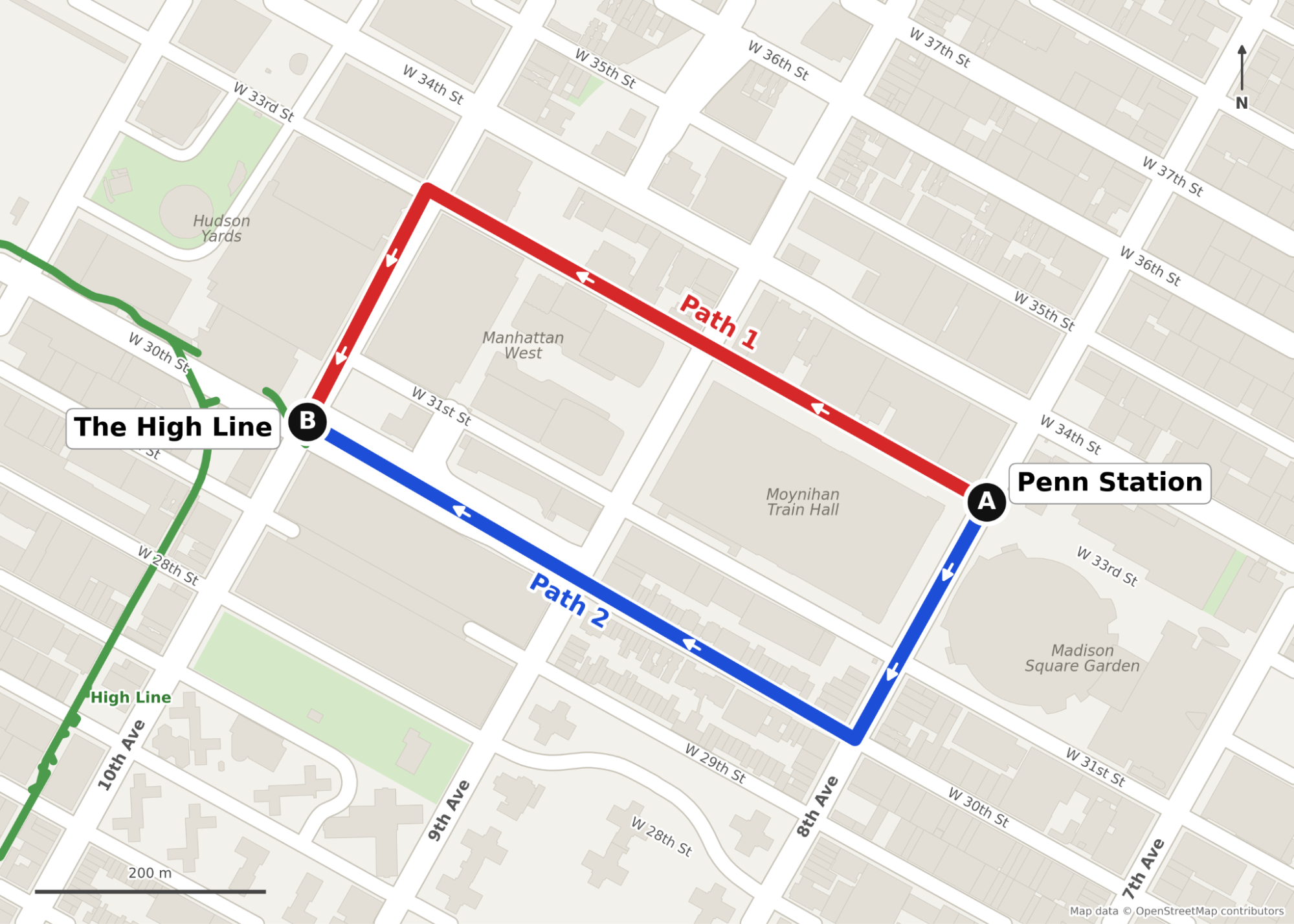
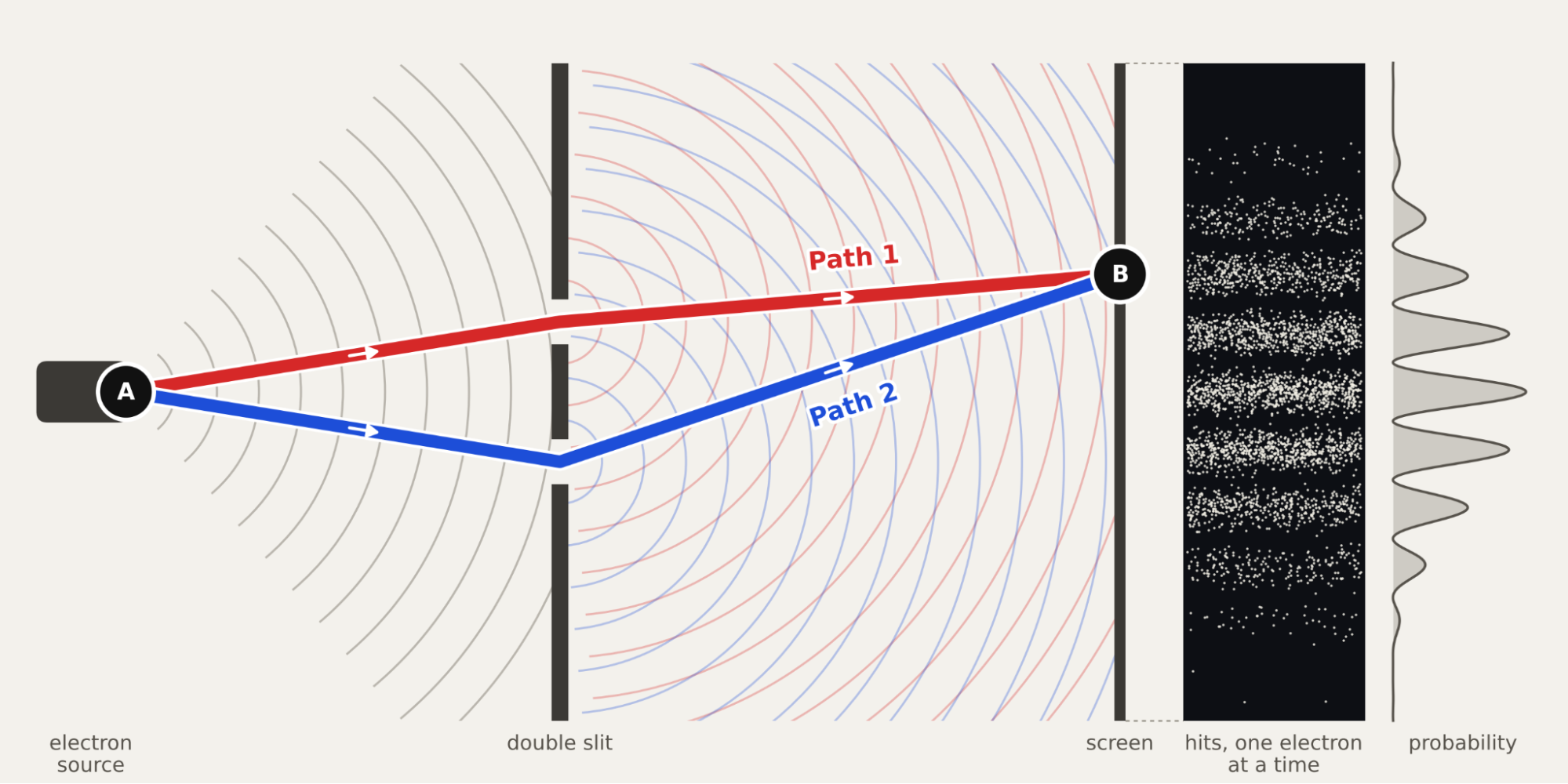
文章先用纽约走路和双缝实验说明量子里的「所有历史加总」。从宾州车站到高线入口,西33街往西再往南,或先往南再沿西30街往西,对人来说必须选一条;对量子粒子来说,两条可以同时算进去。双缝实验里,电子一个一个打过去,每个都落在屏上某一点,但点多了会积成条纹,这种条纹只有每个电子都同时穿过两条缝才解释得通。
媒体未能载入,请通过下方原文链接查看。
媒体未能载入,请通过下方原文链接查看。
推广到引力,要加总的就不再是粒子路径,而是时空本身可能采取的每一种形状。没人完全知道该怎么加。霍金和佩奇找到一个既简单又还有内容的例子:反德西特时空。直观说法是一只大碗,东西扔出去还会滚回来。我们的宇宙不是这样。区别在于宇宙学常数,也就是真空能量:我们这边是正的,空间膨胀会越来越快;反德西特里是负的,东西会被拉回起点。他们选这个宇宙,是因为它加热后能维持稳定温度。
在给定温度下,真正起作用的历史主要有两个。一个是碗里装满粒子气,其中包含被认为传递引力的引力子;另一个是碗里有一个黑洞。谁对总和贡献更大,谁就「赢」。低温时气体赢,高温时黑洞赢。到了后来称为霍金-佩奇温度的那一点,宇宙会突然从一种切到另一种。

媒体未能载入,请通过下方原文链接查看。
这套计算靠广义相对论。它只在宇宙很大、时空形状还清楚时成立。宇宙缩小到那段描述失效的尺度,时空会失去确定形状,变得模糊,引力这一侧没人会算。对偶的量子这一侧,至少原则上还能算。
1999年,物理学家发现弱耦合那边也有相变,但不知道它是突然的还是平滑的。2003年,Ofer Aharony、Joseph Marsano、Shiraz Minwalla、Kyriakos Papadodimas和Mark Van Raamsdonk等人把能裁定这个问题的计算写了出来,预印本是https://arxiv.org/abs/hep-th/0310285,但完整计算一直没做完。
弱耦合对应的,是时空已经看不清的那一侧
博客随后补上全息对偶的来路。1970年代,Jacob Bekenstein和霍金发现,黑洞能容纳的信息跟表面积成正比,而不是跟体积成正比。1990年代初,Gerard 't Hooft和Leonard Susskind把这个想法推到引力本身:一块空间内部的全部信息,可以写在它的边界上。1997年,Juan Maldacena写得更具体:反德西特这只碗里面的引力,等价于碗沿上一个完全没有引力的普通量子理论。
Claude研究的这个例子里,碗沿上的理论是N=4超杨-米尔斯理论。官方还加了一句:Claude以前在这个理论里算过粒子相互作用,并写过到新精度的结果。弱耦合,也就是粒子几乎不互相作用,对应引力一侧那个又小又模糊的宇宙。眼下物理学家只能在弱耦合下把这套理论分析得很细。
Bo Sundborg在1999年,以及后来的Aharony等人,已经证明弱耦合下碗沿理论升温时也会发生转变。微扰计算按圈数一步步加修正。2003年,Aharony这组人意识到,相变是突然跳还是慢慢变,取决于一个只在三圈才出现的数字。2005年,同一组人在一个更简单的近亲理论上算完了,得到的是突然转变。N=4超杨-米尔斯这一版的计算量大了十倍以上,一直没做完。
Claude的做法是开一个由自身副本组成的小型研究组,几乎每一段计算都独立完成,并拿已知结果核对。它给出的结论是:相变是突然的。两端都出现同一种突然切换,博客据此认为,黑洞形成不只是相对论里的现象,而是写进了底层量子理论。
官方还写了突然转变的一个附带现象:输的那一侧可以暂时活着,类似极纯的水在微波炉里可以超热到100°C以上还不沸腾。高于霍金-佩奇温度时,热的引力子气体也可以长时间处在超热状态。再往上到某个更高温度,它就活不下去了,这是哈格多恩转变,被看作弦论的一个特征信号。引力一侧这个转变还有许多性质,官方认为值得仔细核查它们是否也出现在N=4超杨-米尔斯理论里。
预印本摘要把那个决定性数字写出来了。在自由能里Polyakov环的有效作用量中,四次项系数是b = -1.48×10⁻³ λ²,λ是't Hooft耦合。符号为负,意味着这是一级相变。转变略低于哈格多恩温度;三个鞍点出现、交换主导、再消失的次序,和热反德西特以及小黑洞、大黑洞的次序一样。摘要还写,计算用的是哈密顿方法,几乎每个数字都用两种独立方法得到,并复现了从可积性已知的二圈哈格多恩温度,以及封闭子扇区里的精确结果。预印本的出处说明写的是:内部Claude研究模型在物理学家提示下得到结果,物理学家对照了若干已知特例;另一次用不同方法、未收入这篇预印本的Claude计算,给出了同一个结果。
最简模块自洽能把上限压到哪里
第二项结果换了一个更简单的模型宇宙:两维空间加一维时间,也就是三维时空里的引力。全息对偶下,反德西特碗里的三维引力,等价于碗沿上的普通量子理论。它比真实情况简单,但仍有黑洞,也仍有类似的谜。
媒体未能载入,请通过下方原文链接查看。
媒体未能载入,请通过下方原文链接查看。
博客写,在普朗克尺度,也就是原文所说「大约10-35米」、量子效应已经无法忽略的地方,黑洞是由大量微小单元组成的。物理学家相信我们这个四维宇宙也是如此,但三维版本更容易用全息对偶分析。三维引力本身甚至还没有一个精确的定义,所以更常见的做法是先排除内部自相矛盾的理论。这种方法叫自洽,也就是bootstrap。
2012年,自洽方法曾被用来求解三维临界伊辛模型。2009年,Simeon Hellerman把这种方法用到三维引力上,称为模块自洽。反德西特三维引力里有一个中心荷c,大致对应宇宙由多少微观单元组成。Hellerman证明,任何自洽的三维引力理论里,最轻那个非真空主场的质量M₁最大只能到c/6,再加一些小修正。
过去15年,物理学家一直在压这个上限。数值计算的结果暗示,模块自洽大概能压到约c/9.1。解析方面,Tom Hartman、Dalimil Mazáč和Leonardo Rastelli证明过c/8.5的上限;这个数比数值暗示的还高,说明当时还没把这种方法用到头。
Claude给出的结果是:最轻黑洞不能重于c/Λ,其中Λ由一个精确公式给出,大约是9.1266。预印本摘要把公式写成Λ_V = 12π² / (π² + 4 arsinh² 1) ≈ 9.1266,并写明此前只知道最佳斜率落在8.503和12之间,而12对应BTZ黑洞阈值。博客强调,这是自洽方法第一次在黑洞已经起作用的量子引力区间里推出精确结果之一;单靠这一版方法,还到不了黑洞刚出现的c/12。
官方的结论写得很克制。第一项是一笔物理学家因为太长、太容易算错而搁了二十年的已知计算;第二项需要一个新想法,从别处借来数学工具。两项工作大部分是自主完成的。它们把一个长期研究方向往前推了一步,但离解决量子引力还很远。
要核查公式、假设和验证范围,需要直接读两篇预印本,不要只停留在博客的通俗解释。
原文
Claude solves two open problems in the physics of black holes
媒体未能载入,请通过下方原文链接查看。
媒体未能载入,请通过下方原文链接查看。
媒体未能载入,请通过下方原文链接查看。
媒体未能载入,请通过下方原文链接查看。
媒体未能载入,请通过下方原文链接查看。
媒体未能载入,请通过下方原文链接查看。
Claude solves two open problems in the physics of black holes
Nov 17, 2026
Claude has solved two open problems in theoretical physics. Both concern black holes and the search for a theory of quantum gravity. In the first, it completed a calculation that physicists set up more than 20 years ago, but which had never been solved. Claude’s result showed that a sudden transition associated with the formation of black holes persists even where spacetime no longer has a definite shape. In the second, Claude found the exact limit of the simplest version of a technique used to test candidate theories of quantum gravity. This post explains both findings, first in plain terms and then in more technical detail. The preprints are available here and here.
Introduction
Modern physics rests on two frameworks: general relativity and quantum mechanics. General relativity describes very large things, like stars; quantum mechanics describes very small things, such as atoms. Both are astonishingly good at predicting how the universe behaves, but they’re mathematically incompatible. Finding a theory that unites them—“quantum gravity”—is one of the field’s biggest goals. Black holes are a natural testing ground, because they’re one of the few areas where both relativity and quantum mechanics matter—they pack immense mass into a very small space.
One of the most useful tools for studying quantum gravity is called holographic duality. The real universe has three dimensions of space and one of time, which relativity combines into four-dimensional spacetime. But physicists studying quantum gravity often work with simpler model universes that they can understand in more detail.
The basic idea of holographic duality is that some of these theoretical universes can be described in two ways: as a complete universe with gravity and spacetime, and in quantum terms, with no gravity at all, “written” on the universe’s outer boundary. Just as a real hologram encodes a 3D image on a 2D plane, the quantum model encodes all the information of the universe in one dimension fewer (a universe with four dimensions of space, for instance, can be fully described by a quantum theory with three). This lets physicists turn hard questions about gravity into questions about quantum physics, which are sometimes easier to answer.
The first problem Claude solved concerns what happens when you heat up one of these theoretical universes. At low temperatures, the universe fills up with a gas of particles. Above a certain temperature, a black hole forms instead. In 1983, Stephen Hawking and Don Page showed that this switch is abrupt: it’s a phase transition, similar to how water suddenly boils at 100°C. But Hawking and Page’s calculation relies on general relativity, which holds only when the universe is vast, compared with the tiny scale at which that description breaks down. As the theoretical universe shrinks toward that smaller scale, spacetime loses any definite shape and becomes blurry, and nobody knows how to do the calculation on the gravity side of the duality. On the quantum side, though, the same situation can be calculated, at least in principle.
In 1999, physicists found that there was a phase transition in that regime as well. But they didn’t know whether it was abrupt, like Hawking and Page’s, or smooth. In 2003, a group of physicists set out the calculation that would settle the question, but it was extremely complex and was never completed. Claude did it by running a small research group of copies of itself, in which it worked out almost every piece of the calculation independently and checked its math against known results. It showed that the phase transition is abrupt. The same sudden switch appears at both extremes, suggesting that black hole formation isn’t just a feature of relativity but is actually built into the underlying quantum theory.
The second problem concerns a simplified theoretical universe with two dimensions of space instead of three. This universe is straightforward enough to study in detail, but still has black holes and other mysteries similar to those of our own universe. Even in this simpler universe, physicists don’t know how to create a full theory of quantum gravity, so they approach it from the other direction: rather than building a single, correct theory, they try to rule out wrong ones by showing that they are internally inconsistent. This method is called bootstrapping.
Since 2009, physicists have used a version of this method to set a ceiling on how heavy the lightest black hole in such a universe could be. Any theory that breaks the ceiling is ruled out, and each lowering of the ceiling narrows the search. Results from numerical calculations hinted at where the best possible ceiling lay, but they couldn’t prove it, and the best proven ceiling was well short of what the numerical results suggested.
Claude Fable 5.2 noticed a pattern in the numerical results that physicists had missed and borrowed a method from elsewhere in math and physics to calculate the precise ceiling for the simplest version of this technique and prove that it could not be lowered. It doesn’t identify the correct theory, but it may point physicists in the right direction.
Neither result describes our own universe directly, and neither has practical applications, but both contribute to a long-running theoretical effort to understand how quantum mechanics and relativity fit together.
In the rest of this post, we explain in more detail what each problem was and what Claude did to solve them.
A note about Claude’s methods
In August, an Anthropic researcher, Hongbin Chen, was testing Claude’s capabilities as a side project. He asked Claude to draw up a list of interesting open problems in theoretical physics, specifically focusing on black holes and the bootstrap method. Claude came back hours later with 22 candidates, and Hongbin set up separate agents to work on each one; they could read each other’s progress posts and collaborate when working on related problems. The agents ran in the background, with no special setup, for about six weeks.
The agents solved the two problems in this post. One was the Hawking-Page phase transition, the question of when a hot gas turns into a black hole. Weeks after one of the agents reached a solution, a physicist, who had independently used Claude to tackle the same problem, shared his result, and a colleague realized that Hongbin’s agent had reached the same answer earlier. The two solutions used different methods, so they were a useful check on each other.
The modular bootstrap result came from several agents. The one that was assigned the problem spotted the pattern in the numerical results when surveying the bootstrap literature, and another one—which was working on a mathematically related problem about how tightly spheres can be packed into a high-dimensional space—turned that pattern into a method. It found that this method reproduced a sphere-packing result recently proved by an OpenAI model. Claude then applied the same method to the bootstrap problem, which an earlier Claude agent had tried, and failed, to solve in 61 parallel attempts. Two other agents also independently arrived at the same answer. One half of the final proof, showing that the ceiling can’t be lowered, follows the strategy of the OpenAI proof. In September, the results were formally verified in Lean, a computerized proof checker. Claude then wrote the paper with minimal guidance, and a physicist checked every main result.
The Hawking-Page transition
To understand the first problem, we need to start with something much more familiar: a walk through New York City.
Two equally good routes from Penn Station (A) to the High Line entrance (B). In theory, a quantum particle can take both simultaneously.
Imagine that you’re heading from Penn Station to the High Line entrance on West 30th Street and 10th Avenue, and there are two equally good routes. You could walk west along West 33rd Street and turn south, or head south first and then walk west along West 30th Street. Either way, you have to pick one. In the quantum world, though, that’s not true: a particle can take both routes simultaneously.
This is most clearly demonstrated in the famous double-slit experiment. In this test, you fire particles, one at a time, at a barrier cut with two narrow slits, and record where, on a screen behind it, each one lands. Each particle lands at a particular point on the screen, as a particle should. But as you fire more of them, they build up a pattern of stripes that would only be possible if each one had passed through both slits, like a wave.
The double-slit experiment. When electrons are fired one at a time from a source (A) toward a barrier with two slits, each lands at a single point on the screen. The hits build up a pattern of stripes that is only possible if each one passed through both slits.
To predict what a quantum particle will do more generally, physicists have to add up every path it could possibly take, known as its possible histories. Not every history counts equally; some contribute far more to the sum than others. It’s an extravagant and mysterious way to describe how a single particle behaves, but it’s also one of the most successful ideas in physics.
This approach, known as the “sum over histories,” is well established for particles and anything made of them. But what about gravity? Einstein showed that gravity is a consequence of curved spacetime: objects with mass bend space and time around them, and we feel that bending as gravity. In a quantum theory of gravity, therefore, what gets summed over is the shape of spacetime itself, rather than just the paths of particles moving through it. To make predictions in a quantum theory of gravity, we would have to add up every shape that the universe could possibly take, and nobody yet knows how to do that. Much of modern quantum gravity research is an attempt to work it out.
Hawking and Page found a case where this sum is simple enough to handle but still interesting. To explain Hawking and Page’s work, we need to imagine a different kind of universe, called anti-de Sitter spacetime. Imagine you’re standing in a giant bowl. No matter how hard you throw an object, it will always roll back to the place you threw it from.
Our universe isn’t like that. The difference comes down to a quantity called the cosmological constant, which describes the energy of empty space. In our universe, this energy is positive, which makes space expand ever faster. In anti-de Sitter spacetime, the energy is negative, so everything is pulled back to where it started. Hawking and Page chose this universe for their calculation because of how it behaves when it heats up: the bowl keeps heat in so it can stay at a steady temperature.
At any given temperature, two histories matter far more than all the others. Here, a “history” means an entire version of the universe: a particular shape of spacetime, along with everything in it. In one, the bowl is filled with an ordinary gas of particles—including gravitons, the particles believed to carry gravity. In the other, it contains a black hole. Whichever contributes more to the sum is, in effect, what we would observe—it “wins.” At low temperatures, the gas history wins, and the universe is full of gas; at high temperatures, the black-hole history wins, and the universe contains a black hole. At one particular temperature—which physicists now call the Hawking-Page temperature—the universe switches abruptly from one to the other. This is the phase transition.
Which history wins depends on temperature. Below the Hawking-Page temperature (black line), the universe is filled with a gas of particles, including gravitons; above it, the universe contains a black hole.
It’s a rare case where we can see two very different shapes of spacetime competing in the sum over histories, and can say which one wins.
This is where the holographic principle enters the story. In the 1970s, Jacob Bekenstein and Hawking found that the amount of information a black hole can hold is proportional to its surface area, not to its volume. That’s very different from ordinary matter, where every bit of volume holds roughly the same amount of information.
In the early 1990s, Gerard ’t Hooft and Leonard Susskind proposed that this idea applies to gravity in general—that everything inside a region of space can be fully described by the information on its boundary, just as a flat hologram can display a three-dimensional image. In 1997, Juan Maldacena formalized the idea further. Gravity inside the anti-de Sitter bowl, he argued, is equivalent to an ordinary quantum theory of particles, with no gravity at all, existing on the rim of the bowl (the universe’s outer boundary). These are the gravity side and the quantum side of the duality we described in the introduction—they’re two languages for describing the same underlying reality.
In the case Claude studied, the quantum theory on the rim is called N=4 super Yang-Mills theory. It’s related to the theories that describe how particles interact in the real universe, but it has extra symmetries that make it much easier for physicists to work with. (Claude has worked with this theory before, calculating how particles interact within it to a new level of precision.) Since the gravity side predicts two histories competing with each other, the obvious question is: does N=4 super Yang-Mills theory (the quantum side) show the same thing?
For now, physicists can analyze this theory in detail only when its particles barely interact with each other, a condition known as weak coupling. This is the opposite end of the spectrum from where Hawking and Page’s gravitational calculation works. Weak coupling on the quantum side corresponds to the small, blurry universe on the gravity side. So there was no guarantee that any of Hawking and Page’s findings would hold there.
Remarkably, they do. Bo Sundborg in 1999, and after him Ofer Aharony, Joseph Marsano, Shiraz Minwalla, Kyriakos Papadodimas, and Mark Van Raamsdonk, showed that even at weak coupling, the theory on the rim goes through a transition as it heats up. This is its counterpart of the switch from gas to black hole inside the bowl. But it was still unknown whether this transition is abrupt, like Hawking and Page’s, or smooth and gradual.
When particles barely interact, physicists have to calculate how they behave one step at a time. They start with a simplified version of the theory in which particles don’t interact at all. Then they add a series of corrections, each more precise and harder to compute than the last. Physicists call these steps loops. In 2003, Aharony and his colleagues realized that whether the phase transition was an abrupt jump, as Hawking and Page predicted, or gradual, hinged on a single number that appeared only three loops in. Computing that number involves many thousands of terms, known as diagrams—far too many to work through by hand. In 2005, the same group completed the calculation for a simpler cousin of the theory and found an abrupt transition. But the version for N=4 super Yang-Mills, more than 10 times larger, was never completed.
The scale of the computational problem, while daunting, wasn’t the only obstacle to completing the calculation. There was a conceptual issue, as well: naively adding up all the parts of the calculation gives an infinite answer, and those infinities have to be tamed carefully to extract a meaningful result.
To solve the problem, Claude ran a small research group of agents, all copies of itself. Almost every piece of the calculation was done twice, by agents acting independently. For extra consistency checks, parts of the calculation could also be compared to previous results in the literature.
The result Claude found is an abrupt jump as the temperature rises, exactly analogous to what Hawking and Page had found using the sum over spacetime histories. The emerging picture is very simple: the transition is abrupt at both weak and strong coupling—the blurry and the smooth ends, in the gravity description. The most natural possibility is that it stays abrupt everywhere in between.
This is a beautiful outcome. It shows that a calculation using the sum over histories in gravity qualitatively matches the behavior of an ordinary quantum theory with no gravity at all.
Many open questions remain. The abrupt transition Claude found is very much like the one we see whenever we boil water. One interesting feature of abrupt transitions is that the losing side of the competition can survive for a while: for instance, water can be superheated above 100°C without boiling, as you could see for yourself if you were to put a cup of extremely pure water in the microwave. (But please don’t do this; it’s dangerous, and Anthropic would rather not be responsible for an epidemic of scalded readers.)
Something similar happens here. Above the Hawking-Page temperature, the hot gas of gravitons and other particles can survive for a long time in a superheated state. But at a higher temperature it can no longer survive: this is another transition, the Hagedorn transition, which is a characteristic signature of string theory. On the gravity side, that transition has many interesting properties of its own, and it would be valuable to check in detail whether they also appear in N=4 super Yang-Mills theory.
Another open question concerns the other possible histories of spacetime. Hawking and Page considered three: one in which their model universe is filled with gas, one that contains a large black hole, and one containing a smaller black hole that never comes to dominate the sum over histories. In principle, there are many more possible histories. As far as anyone knows, none of them ever dominates. But given certain changes to the starting conditions—if the universe is set spinning, for instance, or given a fixed amount of energy or charge—then some of these histories do take over. Working out exactly which ones win, and when, is an interesting problem for the future.
The modular bootstrap
As we saw earlier, one useful model universe has just two dimensions of space and one of time: it’s called “3D gravity” because it describes gravity in three spacetime dimensions. According to the principle of holographic duality, 3D gravity inside the anti-de Sitter bowl is equivalent to an ordinary quantum theory living on the bowl’s rim.
As a model, 3D gravity is much simpler than the real thing, but it still allows for black holes and many of the same mysteries. It provides a useful laboratory for studying the sum over spacetime histories. It’s also a good place to test the idea that spacetime isn’t a basic ingredient of the universe, but emerges from something deeper. In general relativity, black holes look smooth. But in quantum gravity, if you zoom in to the smallest scales—the Planck length, around 10-35 meters, where quantum effects on gravity become impossible to ignore—black holes are made of an enormous number of tiny, individual building blocks. Physicists believe the same is true in our own, four-dimensional universe, but the 3D version is much easier to analyze with holographic duality.
Claude’s results build on a method called the bootstrap, a general strategy for solving quantum theories. Counterintuitively, the strategy doesn’t try to solve a theory directly. For 3D gravity, that isn’t even possible, because nobody knows how to define the theory precisely. Instead, the bootstrap rules theories out by showing that they contradict themselves. Physicists scan over all possible quantum theories and try to eliminate them one by one.
Remarkably, in many cases this method makes it possible to pinpoint a single quantum theory and calculate precisely how it behaves. The requirements of relativity and quantum mechanics are so demanding, and so delicately balanced, that together they rule out every alternative. In 2012, the bootstrap was used to solve a quantum field theory called the 3D critical Ising model, a simple model of magnetism that also describes water at the point where liquid and vapor become indistinguishable. Since then, it has been applied to many different quantum systems.
In 2009, Simeon Hellerman introduced a technique called the modular bootstrap, which applies the bootstrap method to 3D gravity. Its goal is to rule out inconsistent theories of quantum gravity in three spacetime dimensions. By combining it with other bootstrap methods, physicists hope to eventually eliminate every inconsistent theory. Whatever is left must be consistent. There could be no consistent theories, or just one, or whole families of them. Any of these outcomes would be interesting, because it would help us understand what spacetime looks like at the Planck scale in this simplified universe, and give us hints about the Planck scale in our own.
Here’s how the modular bootstrap works. 3D gravity in anti-de Sitter spacetime has a quantity called the central charge (c), which roughly counts how many microscopic building blocks the universe is made of. When general relativity holds, c is very large, because large black holes contain an enormous number of building blocks. A second quantity, M₁, is the mass of the lightest black hole. To run the bootstrap, physicists scan over every possible theory, with every possible value of c and M₁, and look for inconsistencies.
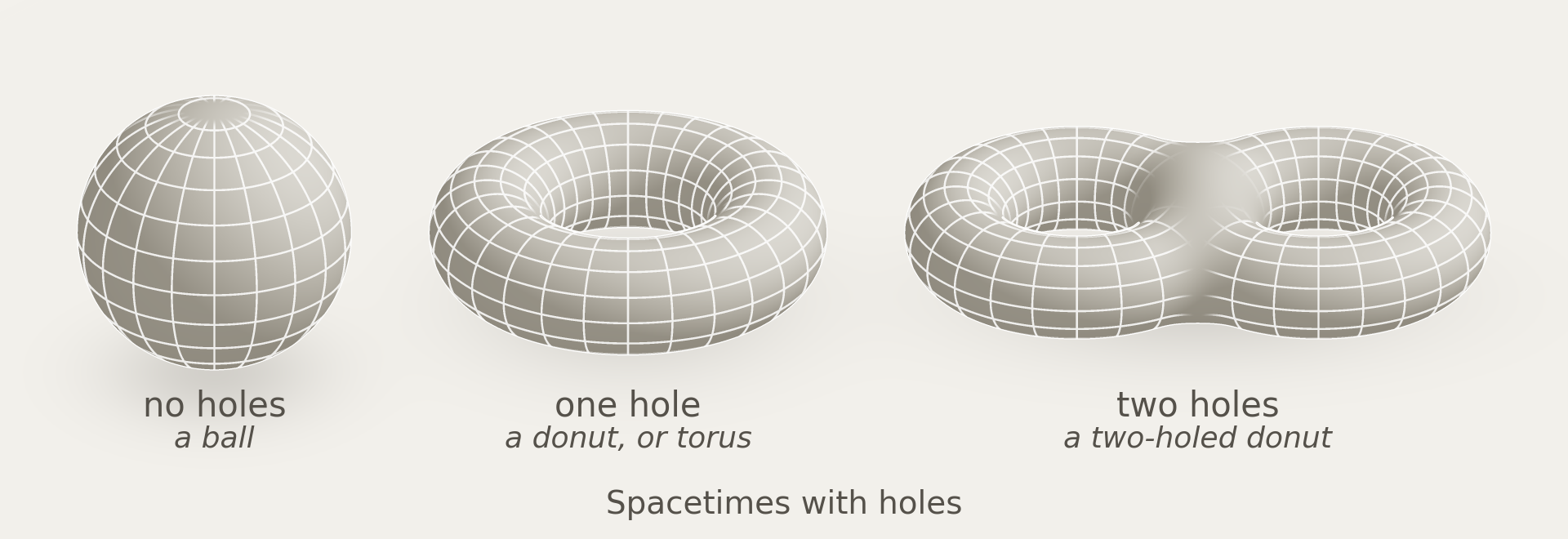
To understand how that search works, we need to go back to the sum over spacetime histories. In 3D gravity, that means adding up different 3D shapes of spacetime. They can be simple, like a ball, or more complicated, like the donut and two-holed donut in the figure below. The spacetime is the inside of the shape—the dough inside the donut. Its surface, like the rim of the bowl in the earlier section, is where the quantum theory is “written,” in one fewer dimension.
Three possible shapes of spacetime in 3D gravity: a ball, a donut (or torus), and a two-holed donut. The spacetime is the inside of each shape, and the quantum theory is “written” on its surface.
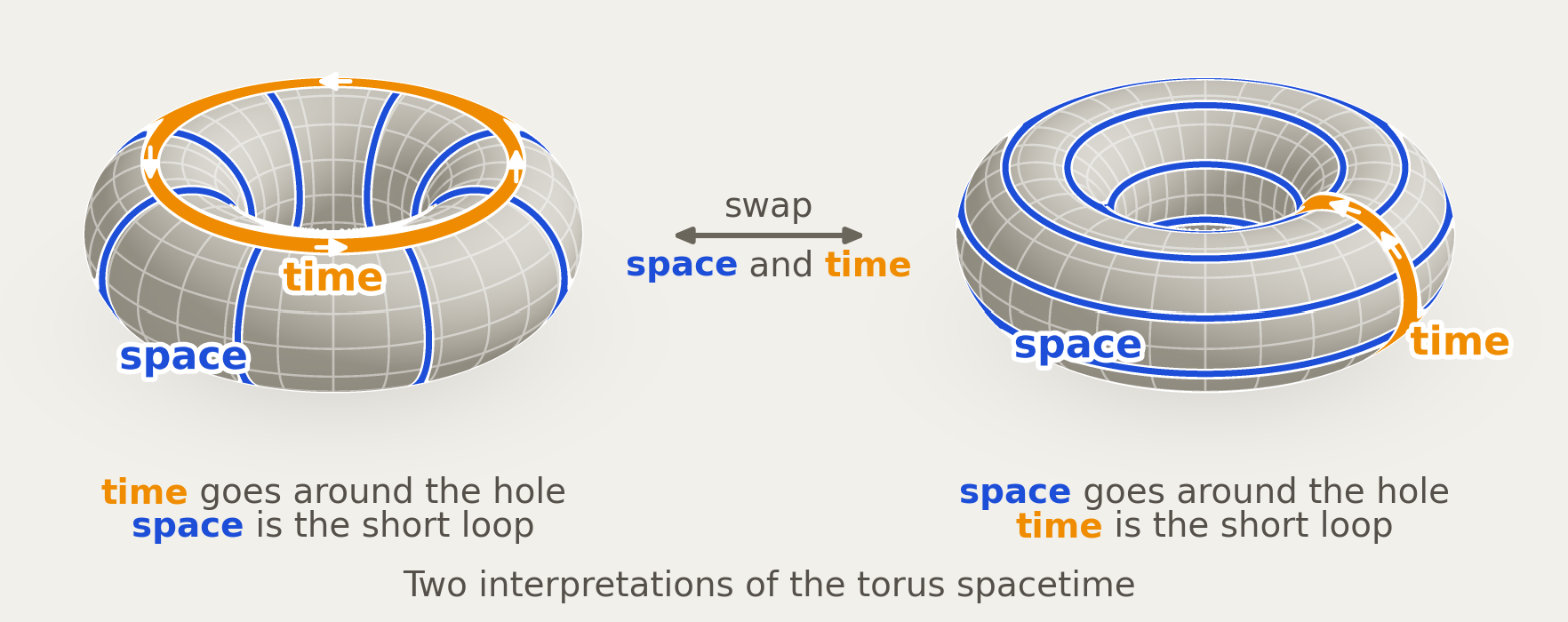
The modular bootstrap starts with a spacetime shaped like an ordinary, one-holed donut, or torus. There are two different ways to interpret this shape, depending on which direction we call “time” and which we call “space.” In the first, the long direction around the hole is time and the other, shorter loop, around the tube, is space. In the second, they’re swapped: the long loop is space and the shorter loop is time.
Two ways to interpret the same donut-shaped spacetime. (left) Time runs the long way around the hole, and space is represented by the shorter loop; (right) space runs the long way around, and time is represented by the shorter loop.
In calculations like these, the length of the time loop sets the temperature: the shorter the loop, the hotter the universe. So swapping the two loops trades a cold universe for a hot one. The two interpretations correspond to the two competing histories that Hawking and Page studied. In 3D gravity there are no gravitons, but there is a transition similar to the one that Claude analyzed in N=4 super Yang-Mills theory.
Now we come to the crucial step. In relativity, space and time are on an equal footing. So it can’t matter which loop we label space and which we label time. As far as relativity is concerned, the two interpretations are equivalent, and the physics must be the same for every possible experiment.
Quantum mechanics, however, treats time differently from space. To calculate anything, you pick a direction to call time and track how the system evolves along it. So, when we calculate observable quantities in quantum gravity, the two interpretations of the donut lead to calculations that look very different. But in relativity, it doesn’t matter which loop is called time, so the two calculations have to give exactly the same answer.
If we knew the theory of 3D quantum gravity, we could do both calculations and confirm that they match. We don’t, but with the bootstrap method, that isn’t a problem. Physicists scan over the possible values of c (the number of building blocks) and M₁ (the mass of the lightest black hole). For each pair of values, they try to prove that the theory would be inconsistent—that the two calculations on the donut couldn’t possibly give the same answer. This involves searching for a special mathematical object called a bootstrap functional. If physicists find one, then the theory is inconsistent, and those values are ruled out.
The hope, supported by the bootstrap’s successes elsewhere, is that combining this approach with other bootstrap methods will eventually rule out most possible theories of 3D quantum gravity. The theories left standing would be the only ones consistent with both gravity and quantum mechanics. Physicists could then use them to explore some of the biggest questions in quantum gravity: is there only one theory? Does it rely on string theory, or are there alternatives? What are black holes made of at the microscopic level, and how do we sum over spacetime histories?
This strategy can work in principle, but it’s very difficult in practice, because bootstrap functionals are hard to find. What matters for quantum gravity is what happens when c is large—but the larger c gets, the harder the search becomes. In the original paper on the modular bootstrap, Hellerman proved that in any consistent theory of 3D gravity, M₁ can be no larger than c/6, up to small corrections. Theories with a heavier lightest black hole can’t possibly be consistent with both gravity and quantum mechanics.
The goal of the modular bootstrap is to push this ceiling as low as possible, pinning down how heavy the lightest black hole can be. Physicists write the ceiling as M₁ ≤ c/Λ. A lower ceiling means a larger number Λ. The results below, including Claude’s, concern the simplest and most-studied version of the method, which ignores how the black holes spin.
Over the past 15 years, physicists have worked to lower the ceiling and pin down the theory as tightly as possible. There are two ways to do this. One is analytical—building a bootstrap functional by hand, with pen-and-paper mathematics. The other is numerical—using computers to search for functionals and optimize them. The results of these numerical calculations suggested that the modular bootstrap could push the ceiling down to about c/9.1. But these calculations get harder as c grows, so they couldn’t settle the question. On the analytical side, Tom Hartman, Dalimil Mazáč, and Leonardo Rastelli proved a ceiling of c/8.5, but because this was higher than the numerical results had suggested, this clearly wasn’t the best the modular bootstrap could do. Since then, just how tightly the modular bootstrap can constrain quantum gravity has remained an open question.
Claude set about solving the problem by running numerical experiments and reproducing results from the literature. In doing so, it noticed a pattern that physicists had so far missed, involving the way the numerical ceiling shifted slightly as c grew. Based on that pattern, Claude developed a hypothesis about the behavior of the bootstrap functional, using a mathematical tool called a spectral curve. Spectral curves are well known in other areas of mathematics and physics, but had never been applied to this problem. Claude found the spectral curve that governs the modular bootstrap at large values of c. It then used it to prove that the lightest black hole in 3D quantum gravity can be no heavier than c/Λ, where Λ is given by an exact formula and is approximately 9.1266. It also proved that this ceiling is optimal: it’s the lowest this version of the modular bootstrap can ever go. Claude delivered the solution across four research notes, which it later merged into a single paper.
This is one of the first times the bootstrap has been used to derive an exact result in the regime of quantum gravity where black holes matter. It also shows that this version of the method can’t, on its own, push the ceiling down to c/12, the mass at which black holes first appear; that will take other ingredients. Although it doesn’t pin down the theory of quantum gravity in three dimensions by itself, it provides a starting point and helps to narrow the search.
Conclusion
These two results show Claude doing two very different kinds of research. The first is a known calculation that physicists had set aside for two decades, because the work was too long and error-prone to complete by hand. The second required a new idea: spotting a pattern others had missed and bringing in a mathematical tool from another area of physics. Both were carried out largely autonomously. Neither result settles the question of quantum gravity, or even comes close to doing so, but each pushes physics forward in a longstanding area of research.
Read the black hole phase transition paper here, and the modular bootstrap paper here.